

Almost every app brief that lands on our desk in 2026 mentions AI. That’s new. A couple of years ago AI was a “phase two” idea, something to add once the real app was built. Now it’s assumed from the first conversation.
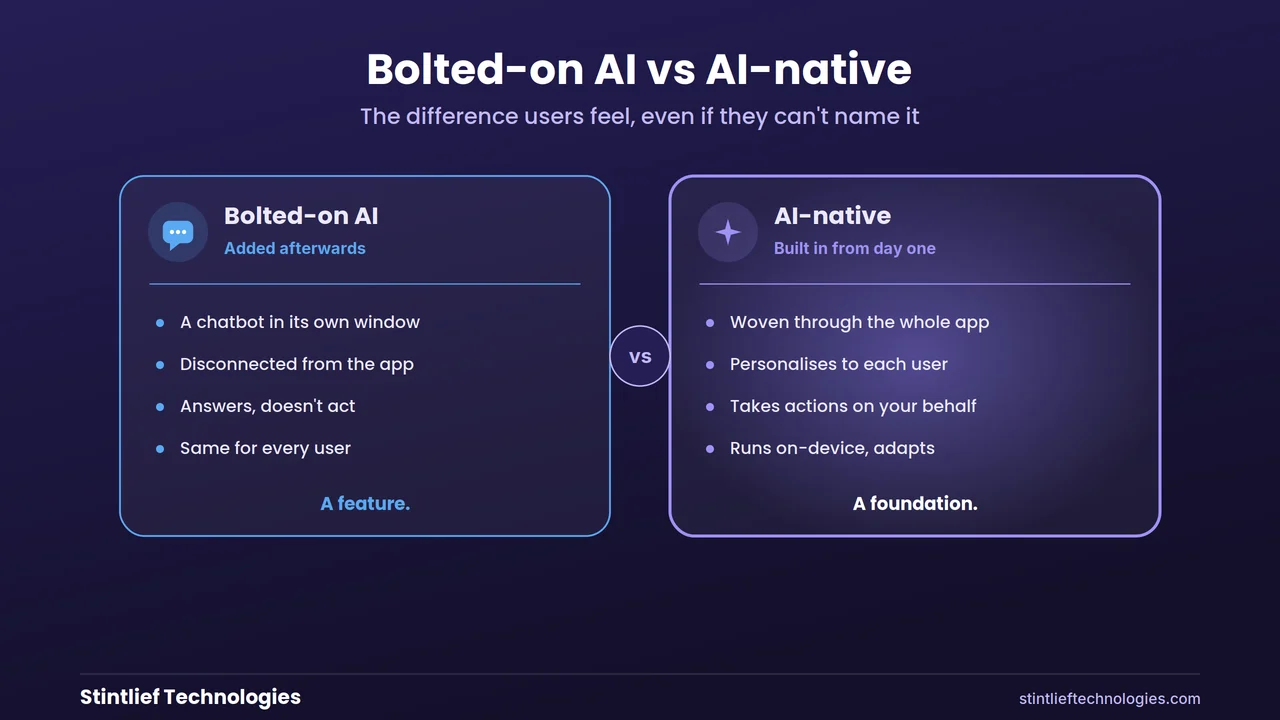
But there’s a catch, and it separates the apps that feel genuinely intelligent from the ones that feel like they’re wearing AI as a costume. Most apps that claim to “have AI” have simply bolted a chatbot onto an otherwise ordinary product. The AI sits in a corner, in its own little window, disconnected from everything the app actually does. It’s a feature, not a foundation.
An AI-native app is the opposite. Intelligence is built into the core from day one, woven through how the app works rather than parked in a chat bubble. That difference sounds subtle. In practice it decides whether your app feels like the future or like last year’s product with a sticker on it.
Bolted-on AI vs AI-native, in plain terms
Picture two food-delivery apps.
The first one added an AI chatbot. You tap a help icon, a window opens, you ask “where’s my order,” and it answers. Useful, mildly. But the rest of the app is exactly as it always was. The AI is a bouncer at a side door, not part of the building.
The second one is AI-native. It notices you usually order dinner around 8pm on weekdays and quietly surfaces your regulars first. It knows you switched to vegetarian last month and reorders the menu accordingly. When your delivery is running late, it proactively messages you with a revised time and a small credit, before you even think to check. There’s no chatbot to open, because the intelligence is everywhere, doing things without being asked.
Same category, same basic function. One feels like software. The other feels like it’s paying attention. That’s the AI-native difference, and users feel it immediately even if they can’t name it.
What actually makes an app AI-native
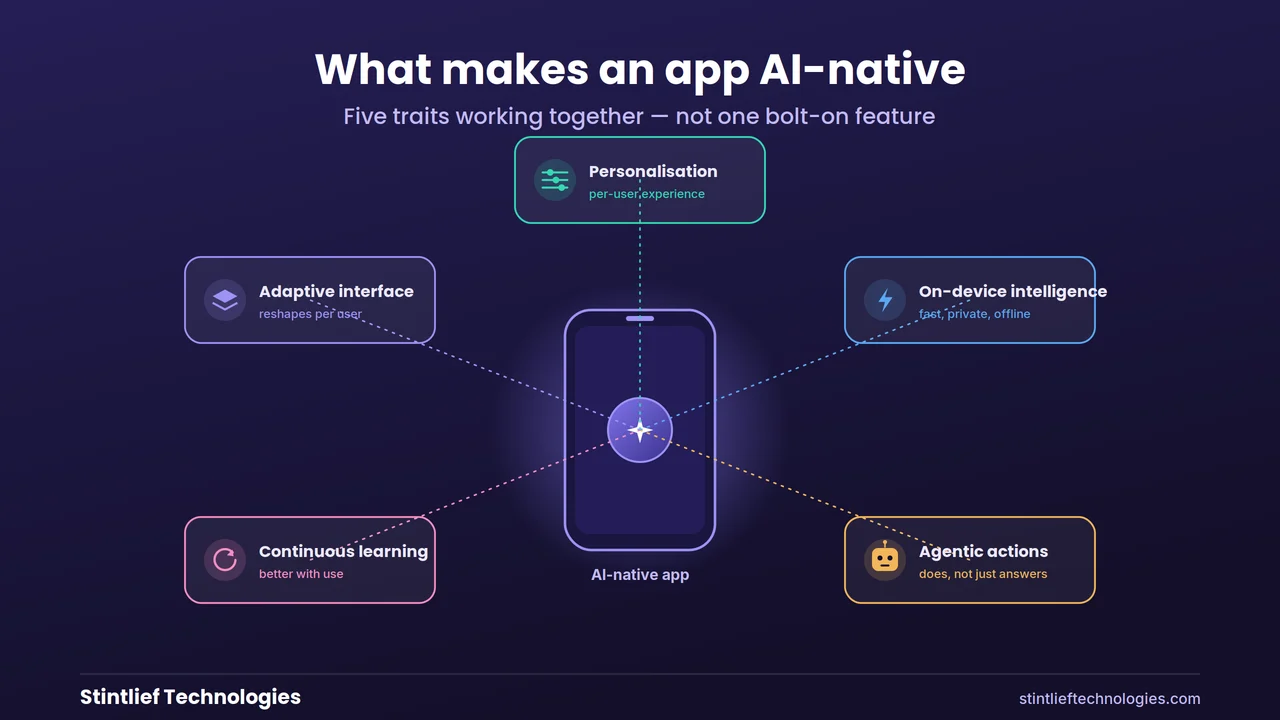
It isn’t one feature. It’s a handful of characteristics working together.
The app personalises itself to each user. Not crude “recommended for you” rows, but a genuinely different experience per person that adapts as behaviour changes. Every user effectively gets their own version of the app.
Intelligence runs close to the user, often on the device. In 2026, smaller models can run on the phone itself for many tasks, which means faster responses, better privacy, and features that work without a constant round-trip to a server. This matters especially in India, where connectivity varies and data costs are real.
The app takes actions, not just answers. This is the agentic shift we wrote about in AI agents for business. An AI-native app doesn’t wait to be asked; it books, reorders, drafts, reminds and completes tasks on the user’s behalf, with the right guardrails.
The interface itself adapts. Instead of one rigid layout for everyone, the app reshapes around what each user needs, showing the right thing at the right moment. This is where AI-native design meets good product thinking, a theme from our piece on AI-powered UI design.
And it learns continuously. The app gets more useful the more it’s used, because it’s improving its understanding of the user over time rather than staying frozen at launch.
Put those together and you get a product that feels less like a tool you operate and more like an assistant that happens to have an interface.
Why “just add a chatbot later” fails
Businesses often ask why they can’t just ship the app now and layer AI on afterwards. Sometimes you can. But there’s a structural reason it usually disappoints.
AI-native features depend on the app being built to feed them. Personalisation needs the right data captured cleanly from the start. On-device intelligence needs an architecture designed for it. Agentic actions need the app’s core functions exposed in a way the AI can safely use. Bolt AI on at the end and it can only reach the surface, which is exactly why bolted-on AI so often ends up as a lonely chatbot that can’t actually do anything.
Building AI-native from day one is not about adding more; it’s about designing the foundation so intelligence can reach everywhere. Retrofitting that later frequently costs more than doing it right the first time, and still delivers less.
This doesn’t mean every app needs to be a science project
A fair word of caution, because “AI-native” is becoming a buzzword and buzzwords lead to overbuilding.
Not every feature needs AI, and forcing it in where a simple button would do makes an app worse, not better. The goal is not maximum AI. The goal is an app that genuinely helps the user, using intelligence where it removes friction and staying out of the way where it doesn’t. Some of the best AI-native apps use their intelligence invisibly, and users never think about the AI at all. They just notice the app rarely wastes their time.
The honest version of AI-native is disciplined, not maximal. Build the intelligence that earns its place, and skip the rest.
What this means if you’re planning an app
If you’re commissioning an app in 2026, a few things follow.
Decide your AI ambitions before you design, not after. The architecture choices made at the start determine what’s possible later, so this is a day-one conversation, not a phase-two one.
Be specific about what the AI should do for the user. “Add AI” is not a brief. “Reorder the home screen around each user’s habits” and “let users complete a booking by voice” are briefs. Concrete jobs lead to good products; vague ambition leads to a chatbot in a corner.
Think about where the intelligence runs. On-device, cloud, or a mix, each has trade-offs in speed, privacy and cost, and the right answer depends on your users. For an Indian audience, on-device and offline-tolerant design often wins.
And choose a build partner who thinks in AI-native terms from the foundation, not one who treats AI as a plugin. This connects to the platform choices we covered in PWA vs native and Flutter vs React Native: the framework matters, but the AI-native architecture underneath matters more.
At Stintlief, this is how we approach app builds now, with AI considered from the first architecture decision rather than added at the end. If you’re planning an app and want it to still feel current two years from now, the most useful starting point is a clear conversation about the handful of things AI should genuinely do for your users.
Frequently asked questions
What is an AI-native app? An AI-native app is one with intelligence built into its core from the start, shaping how the whole app works, rather than a chatbot added on afterwards. Personalisation, actions and the interface itself are driven by AI.
What is the difference between AI-native and bolted-on AI? Bolted-on AI is a feature added to an existing app, usually a chatbot in its own window, disconnected from the rest. AI-native means intelligence runs throughout the app, personalising the experience and taking actions across its core functions.
Does every app need to be AI-native in 2026? Not every feature needs AI, and forcing it in can make an app worse. But building with AI in mind from the start is increasingly worthwhile, because retrofitting intelligence later is harder and more expensive than designing for it upfront.
Can I add AI to my existing app later? Sometimes, but it’s often limited. AI-native features depend on the app being architected to support them, so bolting AI on at the end usually only reaches the surface. Planning for it from the start delivers far more.
What is on-device AI and why does it matter? On-device AI runs smaller models directly on the phone rather than a server. It means faster responses, better privacy and features that work with poor or no connectivity, which is especially valuable for Indian users where data and coverage vary.
How do I start building an AI-native app? Decide what AI should do for your users before designing, write concrete jobs for it rather than “add AI,” choose where the intelligence should run, and work with a partner who designs AI-native from the foundation rather than treating AI as a plugin.
Stintlief Technologies builds AI-native mobile and web apps for businesses across India. If you’re planning an app and want AI built in from the foundation, get in touch.