
Here’s a conversation happening in businesses everywhere, whether the owner knows it or not. An employee is staring at a messy spreadsheet of customer details, or a tricky client email, or a chunk of the company’s code. They’re busy. So they open ChatGPT, paste it in, and ask it to clean it up, summarise it, or fix it. It works. They move on. Nobody approved that tool, nobody logged what went into it, and that customer data now sits on a server the business doesn’t control.
That’s shadow AI: staff using AI tools the business never sanctioned, often with data that should never leave the building. And in 2026 it is not a fringe behaviour. Surveys this year suggest the large majority of employees use unapproved AI tools, and that a big share of what gets pasted in is personal or regulated data. Most of that activity runs through personal accounts the company has no visibility into at all. (These figures come from vendor and survey research, so treat them as directional rather than precise, but the direction is not in doubt.)
The instinct, once an owner realises this is happening, is to ban it. That’s the one move almost guaranteed to make it worse. Here’s what’s actually at stake, and what works instead.
Why this is suddenly everyone’s problem
Two things collided. AI tools became genuinely useful for everyday work, and they became trivially easy to access from any browser or phone. The moment a tool saves a busy person twenty minutes, they’ll use it, with or without permission. This is the same lesson we keep coming back to in our writing on AI agents for business: the technology spreads through a company from the bottom up, not the top down.
The news this month sharpened the point. The major AI providers clarified their data-retention terms, and the headline for business owners is simple: on standard and free tiers, your conversations are typically kept for a period for safety monitoring, and some may be reviewed by humans. That’s not a scandal; it’s normal and disclosed. But it means the comforting assumption that “it’s just a chatbot, it’s private” is wrong. What your staff paste into a free AI tool is not guaranteed to stay yours.
What actually leaks, and why it matters
Not all shadow AI is dangerous. An employee asking ChatGPT to improve the wording of a blog intro is harmless. The risk is specific, and it clusters into three buckets.
Customer and personal data. The most common and most serious. Names, phone numbers, addresses, order histories, KYC documents, pasted in to sort, summarise or draft a reply. A large share of files uploaded to AI tools has been found to contain personal or payment data. Under India’s Digital Personal Data Protection Act, that personal data carries real obligations, and an employee quietly feeding it to an unapproved tool is a compliance problem regardless of how helpful the AI was.
Source code and technical secrets. For any business that builds software, developers pasting proprietary code into AI tools is a leak of the company’s actual intellectual property. Industry telemetry this year put source code as the single most common type of data in AI policy violations. If your product is your code, this is your crown jewels walking out the door.
Internal documents and strategy. Financial figures, contracts, unreleased plans, client lists, pasted in to summarise or analyse. Individually each feels minor. In aggregate it’s a slow bleed of confidential information into systems you don’t control and can’t audit.
The thread tying these together is the same one from our piece on AI-powered cyberattacks: the damage doesn’t come from a dramatic hack. It comes quietly, through ordinary people trying to do their jobs faster.
Why banning it backfires
The reflex is a company-wide “no AI tools” email. It fails for a reason worth understanding.
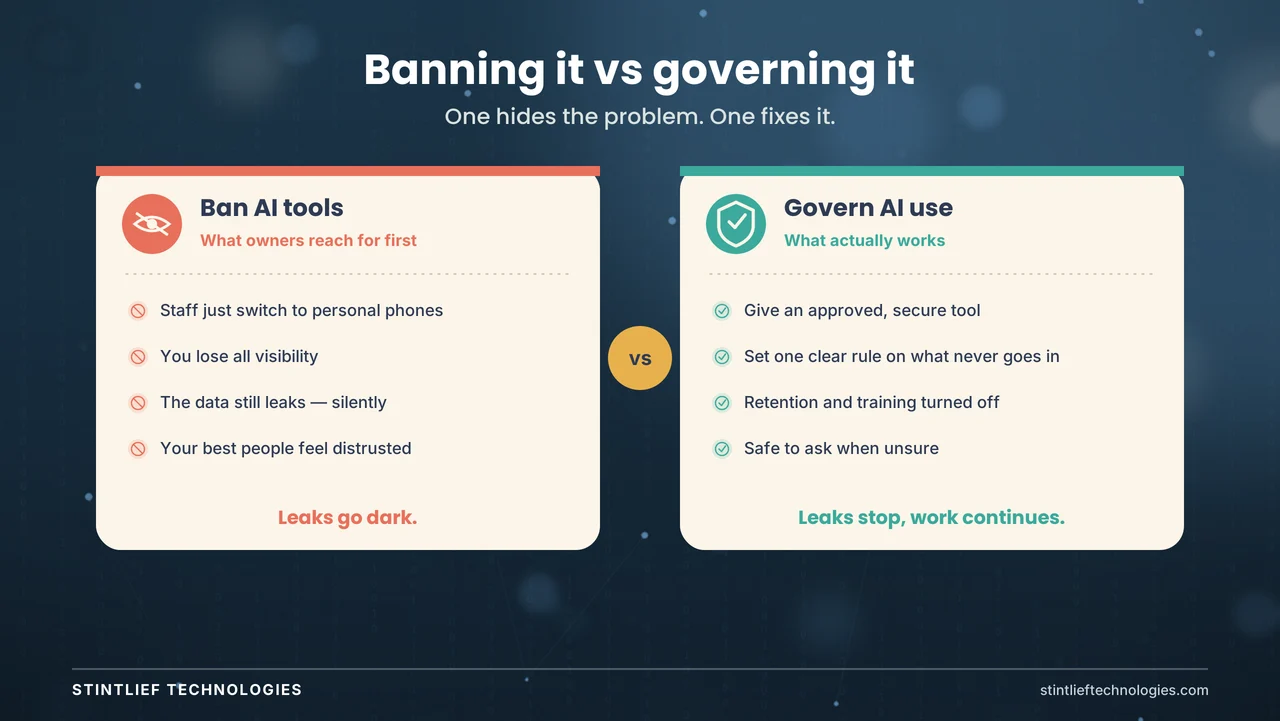
A ban doesn’t remove the temptation; it removes the visibility. The twenty-minute saving is still there, so people keep using AI, just on their personal phones and personal accounts where you can’t see it, log it, or protect it. Research this year found a large chunk of employees simply work around blocked tools. You haven’t stopped shadow AI; you’ve pushed it fully into the shadows, which is the worst of both worlds: the data still leaks, and now you have no way of knowing it’s happening.
There’s a people cost too. A blanket ban tells your most motivated staff that the company would rather they be slow than be trusted. The ones who care most about doing good work are exactly the ones who’ll route around it.
The honest goal isn’t zero AI. It’s AI you can see, on tools you’ve vetted, with clear lines about what never goes in.
How to actually handle it
The approach that works is to replace the temptation, not forbid it. A handful of practical moves cover most of the risk.
Give people an approved tool. The single most effective step. If staff have a sanctioned AI tool, ideally a business-tier account with data-retention controls and training turned off, they have no reason to reach for a personal one. Most leaks happen on personal accounts precisely because that’s all people had. Take that excuse away.
Draw a bright, simple line on what never goes in. People don’t leak data on purpose; they do it because nobody told them where the edge is. A short, blunt rule, never paste customer personal data, source code, or confidential financials into any AI tool, is understood and followed far better than a ten-page policy nobody reads.
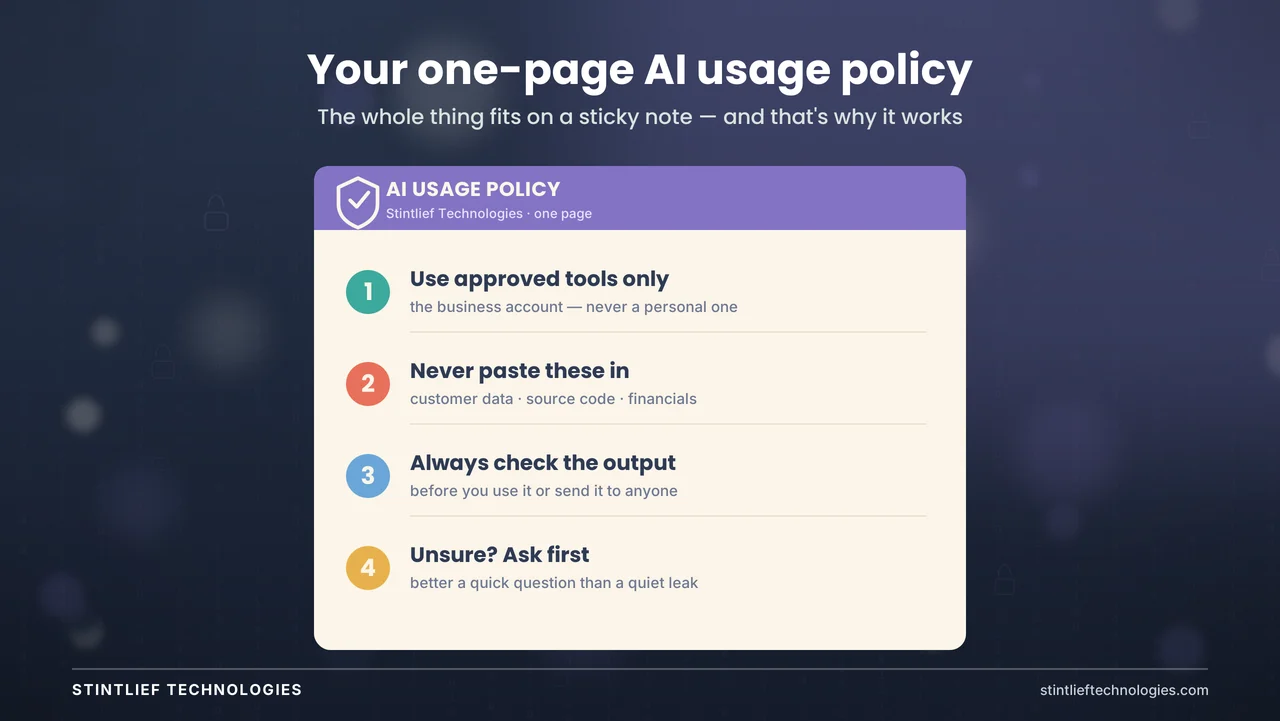
Write a one-page AI policy, not a manual. It needs to answer four questions a normal employee actually has: which tools are approved, what data must never go in, that AI output has to be checked before it’s used or sent, and who to ask when unsure. One page, plain language. That’s it. A policy people can read in two minutes gets followed; a legal document gets ignored.
Teach the retention reality once. A five-minute explanation that free AI tools may keep and review what you type does more than any threat. Once people understand the data doesn’t vanish, the careless pasting drops on its own.
Check your vendors’ terms. For the tools you do approve, know what they retain and whether business-tier settings let you turn off data retention and model training. This is also where the right setup, dedicated business accounts, the correct privacy settings, proper access controls, quietly removes most of the exposure.
Make it safe to ask. The employee who’s unsure whether something is okay to paste should be able to ask without feeling stupid or slow. If asking is safe, they’ll ask. If it isn’t, they’ll guess, and guessing is how data leaks.
The bigger picture for Indian businesses
India has adopted AI tools at breakneck speed, often faster than the governance around them. Combine that with the Digital Personal Data Protection Act’s real obligations on handling personal data, and shadow AI becomes not just an IP risk but a compliance one. “An employee pasted it into ChatGPT” will not satisfy a regulator or a customer whose data ended up somewhere it shouldn’t.
The businesses that get this right in 2026 won’t be the ones that banned AI, nor the ones that ignored the problem and hoped. They’ll be the ones that gave their people good tools, drew clear lines, and made the safe path the easy path. Done well, this isn’t about slowing your team down. It’s about letting them use AI fully, without quietly betting the business on a free chatbot’s privacy settings.
At Stintlief, we help businesses set this up: choosing and configuring the right AI tools with proper data controls, writing a usage policy that fits how your team actually works, and building internal tools so staff get the AI help they want on data that never leaves your control. If you’re not sure what your team is already pasting into AI tools, the most useful first step is simply to ask them, honestly and without blame. The answer is usually a wake-up call, and the fix is more affordable than the leak.
Frequently asked questions
What is shadow AI?
Shadow AI is employees using AI tools the business hasn’t approved, often with company or customer data. It usually happens on personal accounts, so the business has no visibility into what data is being shared or where it ends up.
Is it safe to paste company data into ChatGPT?
Not by default. On free and standard tiers, AI providers may retain your conversations for a period and some may be reviewed by humans. Customer personal data, source code and confidential financials should never be pasted into an unapproved or personal AI account.
Why shouldn’t I just ban AI tools at work?
Because bans remove visibility, not the behaviour. Staff keep using AI on personal devices where you can’t see or protect the data, so the leaks continue and you lose all ability to monitor them. Governing AI use works far better than banning it.
What is an AI usage policy?
A short, plain-language document that tells staff which AI tools are approved, what data must never be entered, that AI output must be checked before use, and who to ask when unsure. One page is enough, and a short policy gets followed where a long one gets ignored.
Does shadow AI break data protection law in India?
It can. India’s Digital Personal Data Protection Act places obligations on how personal data is handled, and feeding customer data into an unapproved AI tool can be a compliance breach, regardless of how useful the AI was or that an employee did it informally.
How do I stop employees leaking data to AI tools?
Give them an approved business-tier AI tool with retention controls, set a clear rule on what never goes in, explain that free tools retain data, and make it safe to ask when unsure. Replacing the temptation works better than forbidding it.
What’s the most common data that leaks through shadow AI?
Research in 2026 points to three types: customer and personal data, proprietary source code, and confidential internal documents like financials and contracts. Source code and regulated data make up a large share of logged AI policy violations.
Stintlief Technologies helps businesses across India adopt AI safely, from choosing and configuring the right tools to building internal tools that keep your data in your control. If you want to get ahead of shadow AI, get in touch.