

A few years ago, the most a business could expect from AI was a chatbot that answered FAQs and then handed everything important to a human. Useful, sometimes. Mostly a glorified search box.
That is not what people mean by AI agents in 2026, and the difference is the whole point.
An AI agent does not just answer. It acts. It reads a customer’s WhatsApp message, checks your inventory, books the order, sends the invoice, and follows up three days later if payment has not come through. Nobody clicked anything. That shift, from software that tells you what to do to software that does it, is the reason “AI agents for business” has gone from a niche developer topic to something we now get asked about in almost every client call at Stintlief.
This piece is for the business owner or operations head trying to figure out whether this is real, where it actually helps, and what it costs to get started in India. No hype. We build these systems, so we will also be honest about where they break.
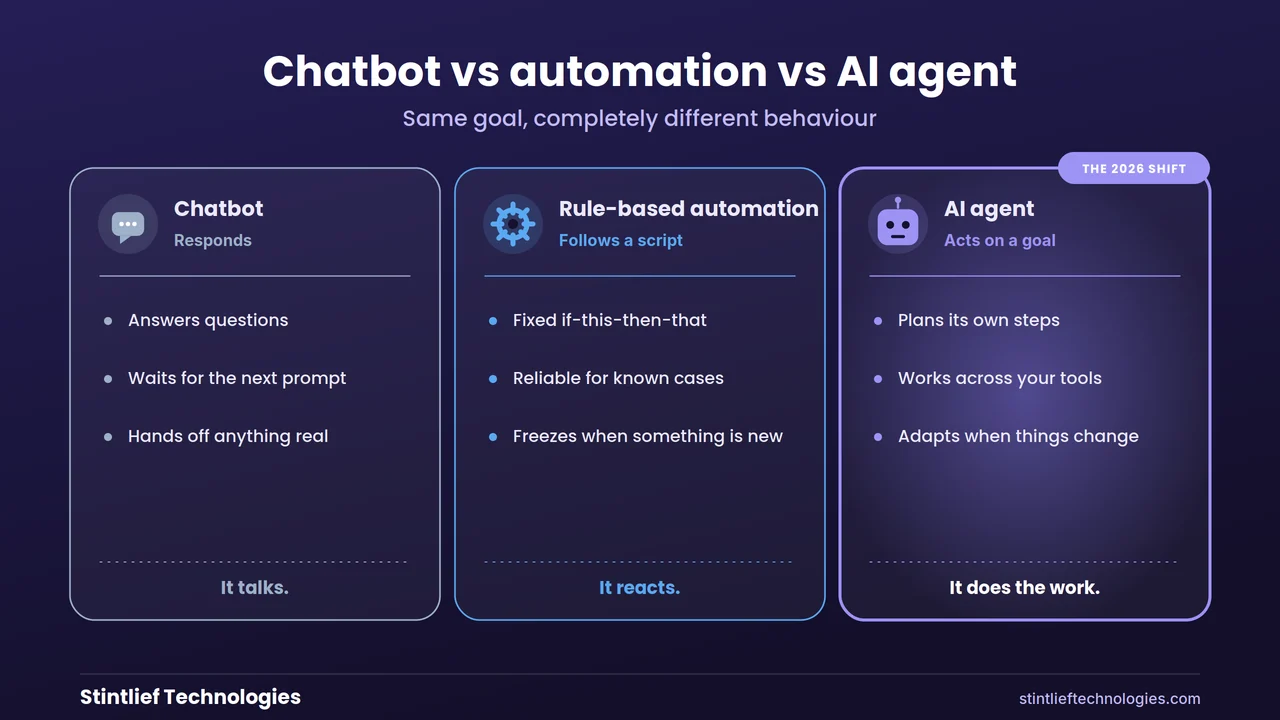
What an AI agent actually is
Start with the distinction that trips most people up.
A chatbot responds. You ask, it replies, the conversation ends. Traditional automation follows fixed rules. If a form is submitted, send email A. If a payment fails, flag it. Reliable, but rigid. The moment something falls outside the rule, it stops and waits for a human.
An AI agent sits above both. It is given a goal, not a script. Say the goal is “make sure every lead from our website gets followed up within an hour.” The agent figures out the steps on its own: read the enquiry, look up what the person asked about, draft a reply in the right tone, send it across email or WhatsApp, log it in the CRM, and schedule a reminder if there is no response. When something unexpected shows up, it adapts instead of freezing.
The simplest way to put it: an API is for programmes, a rulebook is for predictable tasks, and an agent is for the messy work in between that used to need a person.
The jump from agents to agentic AI
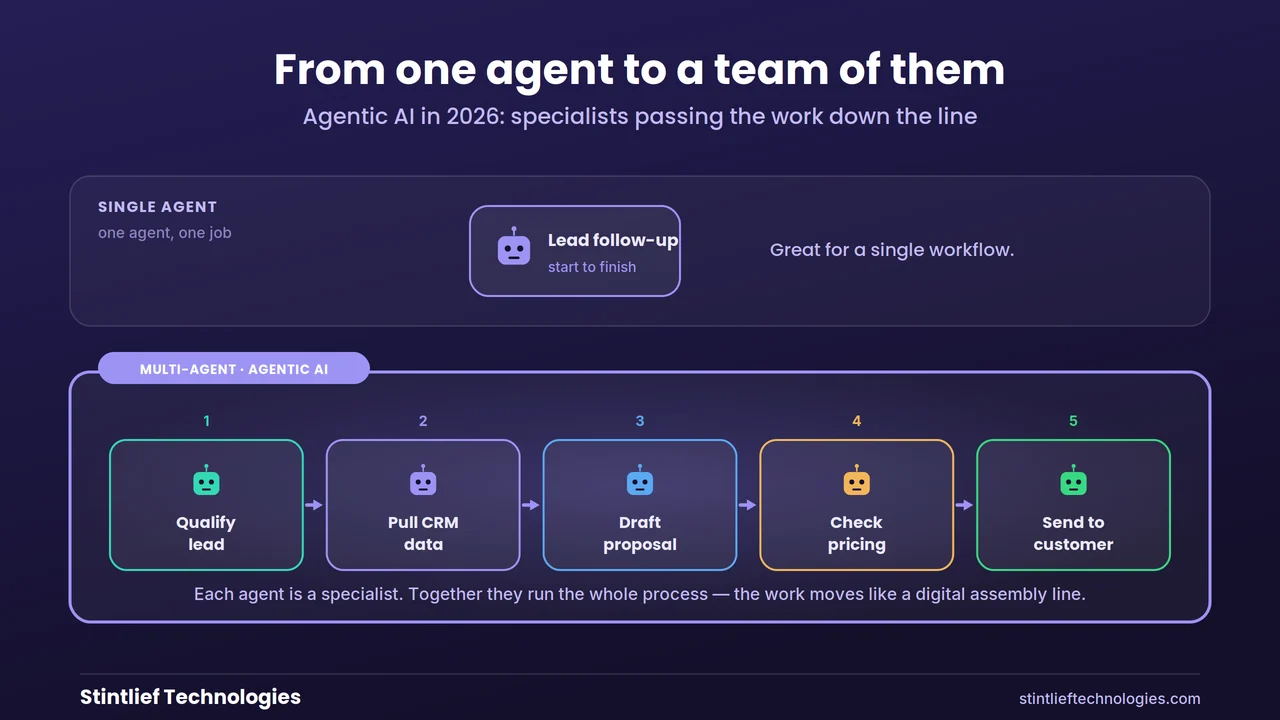
Through 2025, most real deployments used a single agent doing one job. In 2026 the conversation moved to agentic AI, which means several specialised agents working together.
Instead of one all-purpose assistant, you get a small team of them. One agent qualifies the lead. Another pulls data from your CRM. A third drafts the proposal. A fourth checks it against your pricing rules before anything goes out. Google calls this the “agent leap” and describes it as a kind of digital assembly line, where work moves from one agent to the next the way it would move between departments.
This matters because most business inefficiency in India is not a thinking problem. It is an execution problem. Information sits in WhatsApp, decisions wait in someone’s inbox, approvals get chased over phone calls. Multi-agent systems are good at exactly that connective work, the coordination that quietly eats half your team’s day.
If you have read our piece on why AI will not replace developers anytime soon, the same logic applies to your staff. Agents take over the repetitive coordination. People move up to judgement, relationships, and the decisions that actually carry risk.
Where Indian companies are putting agents to work
The theory is fine, but you want to know what this looks like on a Tuesday afternoon in a real business. Here is where we see it landing.
Sales and lead follow-up. This is the most common starting point, and for good reason. Most Indian SMEs lose leads not because the product is wrong but because nobody followed up fast enough. Indian startups like Thriwin have built agents that work across email, WhatsApp and voice calls to chase prospects around the clock, so an enquiry at 11pm gets a reply before a competitor sees it in the morning. If your problem is leads going cold, this pays for itself quickly. We covered the wider playbook in how Indian startups get their first 1,000 customers.
Customer support. Not a chatbot that deflects. An agent that reads the ticket, pulls the customer’s order history, checks the actual status in your system, drafts a real answer, and only escalates the genuinely hard cases to a human. The difference is that it resolves rather than stalls.
Accounts and invoicing. Generating invoices, matching payments, flagging duplicates, sending polite reminders on overdue accounts. Finance teams spend an absurd amount of time on this, and it is some of the most rule-bound work in any company, which makes it a natural fit.
Operations and inventory. Agents that watch stock levels, predict when something will run out, and raise purchase orders before you hit zero. For anyone running a D2C brand or a retail operation, this is where margins quietly improve.
Recruitment and HR. Screening applications, scheduling interviews, answering the same policy questions employees ask every week. The big Indian IT firms are already deep into this. Infosys, for instance, has been running hundreds of generative AI programmes and embedding agents across its operations through its own agentic platform.
Notice the pattern. The best first use case is always something repetitive, data-heavy, and currently done by a person who would rather be doing something else.
Why this is happening now, and why in India specifically
A fair question: AI has been around for years, so why is everyone moving on agents in 2026?
Two things changed. The models got good enough to be trusted with multi-step tasks, and the plumbing got standardised. That second part is underrated. For years, connecting an AI model to your CRM, your billing system and your messaging tools meant building a custom integration for each one and maintaining all of them forever. A shared standard called the Model Context Protocol, which was donated to the Linux Foundation at the end of 2025, changed that. Now an agent can plug into your business tools through one common layer instead of a tangle of one-off connectors. We will cover this properly in an upcoming post, because it is the single biggest reason agents went from demo to production this year.
India has a specific edge here. By the numbers in the Zinnov, Z47 and OpenAI adoption study, India ranks first in the world for AI skill penetration and accounts for roughly a tenth of global ChatGPT traffic, with weekly active users second only to the United States. The talent and the familiarity are already here.
There is also a cost angle that suits Indian businesses well. You do not always need a giant frontier model. Smaller, cheaper models, several of them built to handle Indian languages, can run many of these workflows with far more predictable costs, a point EY makes in its India AI outlook. For a business serving customers in Hindi, Tamil or Marathi, an agent that handles those languages natively is not a nice-to-have. It is the difference between being understood and not.
What it costs, and what tends to go wrong
Here is the part most articles skip.
Agents are not magic, and the failure mode is real. The same adoption research found that while a small share of Indian enterprises are mature AI adopters, close to half are stuck as early adopters still scaling pilots. That gap has a name in our industry: pilot purgatory. The proof of concept works in a demo, then dies when it meets the real, inconsistent data of an actual business.
The usual culprits are worth knowing before you spend anything.
Bad or scattered data. An agent is only as good as what it can read. If your customer records live in three different systems that disagree with each other, the agent inherits that mess.
Hallucination on the edges. Agents are confident even when wrong. For anything involving money, contracts or compliance, you want a human checkpoint, not blind trust. We build these with approval gates for exactly that reason.
Integration that nobody budgeted for. Connecting to legacy systems is where projects quietly overrun. This is genuine engineering, not a plugin you switch on.
Governance, especially in regulated sectors. If you are in financial services, the RBI’s FREE-AI framework now expects board-approved AI policies and proper oversight. You cannot let an autonomous system loose on customer money without a clear record of what it did and why.
On cost, there is no single number, and anyone who quotes you one without seeing your workflows is guessing. A focused single-agent automation for one process is a modest project. A multi-agent system wired across your sales, support and finance tools is a serious build. The honest framing is that you should scope it by the value of the workflow you are automating, not by a flat price.
How to start without setting money on fire
The companies that win with agents do not start big. They start narrow.
Pick one workflow. The best candidate is repetitive, high-volume, and currently annoying a real person on your team. Lead follow-up and invoice reminders are both excellent first projects.
Build a small proof of concept against your real data, not clean sample data. This is the step everyone skips and everyone regrets. Your messy data is the actual test.
Keep a human in the loop at first. Let the agent draft and a person approve. As trust builds, you widen what it can do on its own. This also keeps you on the right side of governance.
Measure something concrete. Response time, conversion rate, hours saved, overdue payments recovered. If you cannot point to a number that moved, you have a science experiment, not a business tool.
Then expand. Once one agent earns its keep, the second one is far easier, because the plumbing and the trust are already there.
Where this is heading
The direction is clear even if the timeline is fuzzy. Gartner expects a large share of enterprise applications to ship with task-specific AI agents built in during 2026, and the broader move is from agents that assist to agents that operate. Software is becoming less a place where you track work and more a place where work gets done.
For Indian businesses, the opportunity right now is the early-mover one. Your competitors are mostly still running pilots. Getting one real agent into production, doing one job well, puts you ahead of the half of the market still stuck in slideware. That is a rare window, and it does not stay open forever.
At Stintlief, this is the kind of work we build, scoped to a real workflow rather than a buzzword. If you are trying to figure out whether an AI agent fits your business, the most useful thing is usually a short conversation about where your team loses the most time. That is almost always where the first agent should go.
Frequently asked questions
What is the difference between an AI agent and a chatbot? A chatbot answers questions and then stops. An AI agent is given a goal and carries out the steps to reach it across your systems, like reading an enquiry, updating your CRM, sending a reply and following up, without a human driving each step.
Are AI agents expensive to build for a small business in India? Not necessarily. A single agent automating one process, such as lead follow-up, is a modest project. Costs rise with the number of systems you connect and the number of agents working together. Smaller, India-friendly language models can also keep running costs predictable.
Which business tasks are best to automate with AI agents first? Start with work that is repetitive and data-heavy: sales lead follow-up, customer support triage, invoicing and payment reminders, and inventory alerts. These have clear value and are easy to measure.
Can AI agents work in Hindi and other Indian languages? Yes. Several smaller language models are built to handle Indian languages well, which means an agent can read and reply to customers in Hindi, Tamil, Marathi and others rather than forcing every interaction into English.
Is it safe to let an AI agent handle payments or contracts? Only with a human approval step. For anything involving money, contracts or compliance, well-built systems keep a person in the loop and log every action. In regulated sectors like banking, India’s FREE-AI framework expects board-level oversight of these systems.
Why are AI agents a bigger deal in 2026 than before? The models became reliable enough for multi-step tasks, and a shared integration standard made it far easier to connect agents to existing business tools. Together they moved agents from demos into real production use.
How do I get started with AI agents for my company? Pick one painful, repetitive workflow, build a small proof of concept against your real data, keep a human approving the output at first, and measure a concrete result before expanding. A development partner can help you scope the first project so it actually ships.
Stintlief Technologies builds custom software, web and app solutions for businesses across India. If you want to explore where an AI agent could save your team time, get in touch.