

Here’s a scenario playing out millions of times a day in 2026. A potential customer has a question that’s squarely in your niche. They don’t open Google and scroll. They ask ChatGPT, or they read the AI Overview at the top of the search page, and they act on the answer without ever clicking a single link. If your business isn’t in that answer, you didn’t just lose a ranking. You were never in the room.
This is the shift behind AI search optimization, often called Generative Engine Optimization or GEO. It’s the practice of getting your content cited by AI engines like ChatGPT, Google AI Overviews, Gemini and Perplexity, so your brand shows up inside the answer itself.
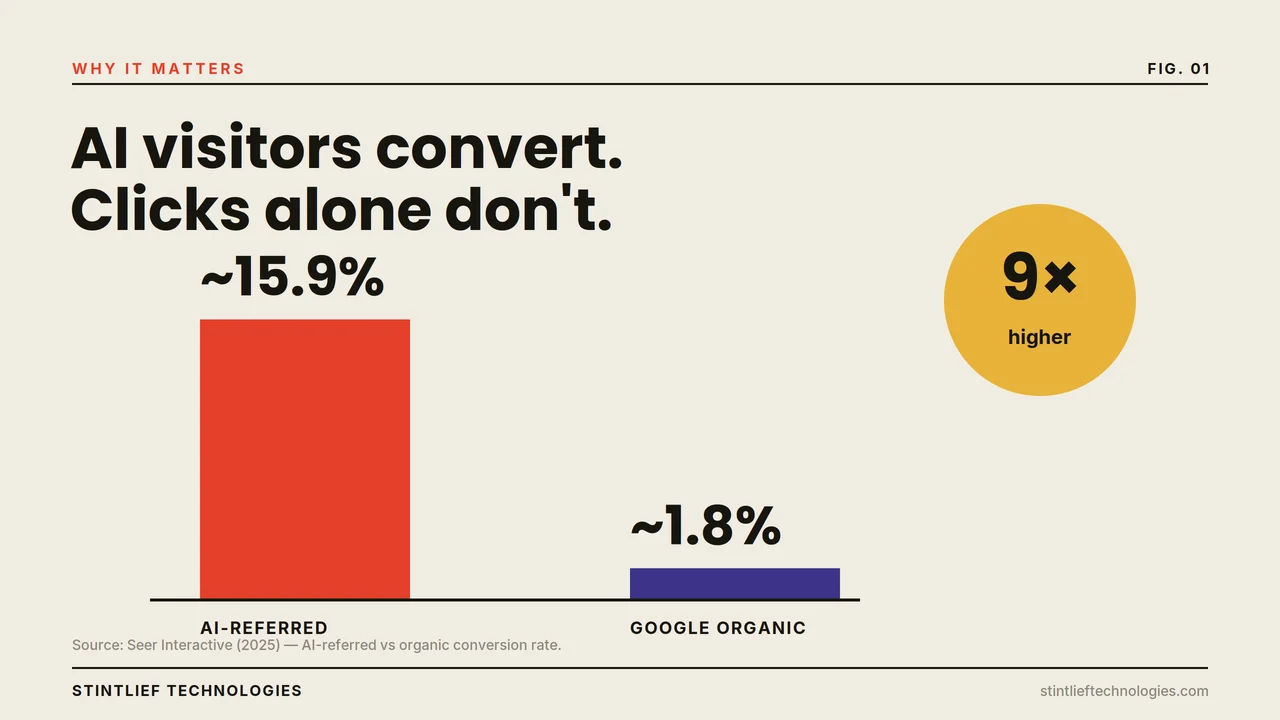
The numbers make the case. Gartner expects traditional search volume to fall by around a quarter through 2026 as people move to AI interfaces. Roughly 60% of searches already end without a click. And the traffic that does come from AI is worth more: studies through 2025 and 2026 found AI-referred visitors converting many times better than organic search visitors, because they arrive with a specific, researched question and a shortlist already forming. Being on that shortlist is the whole game.
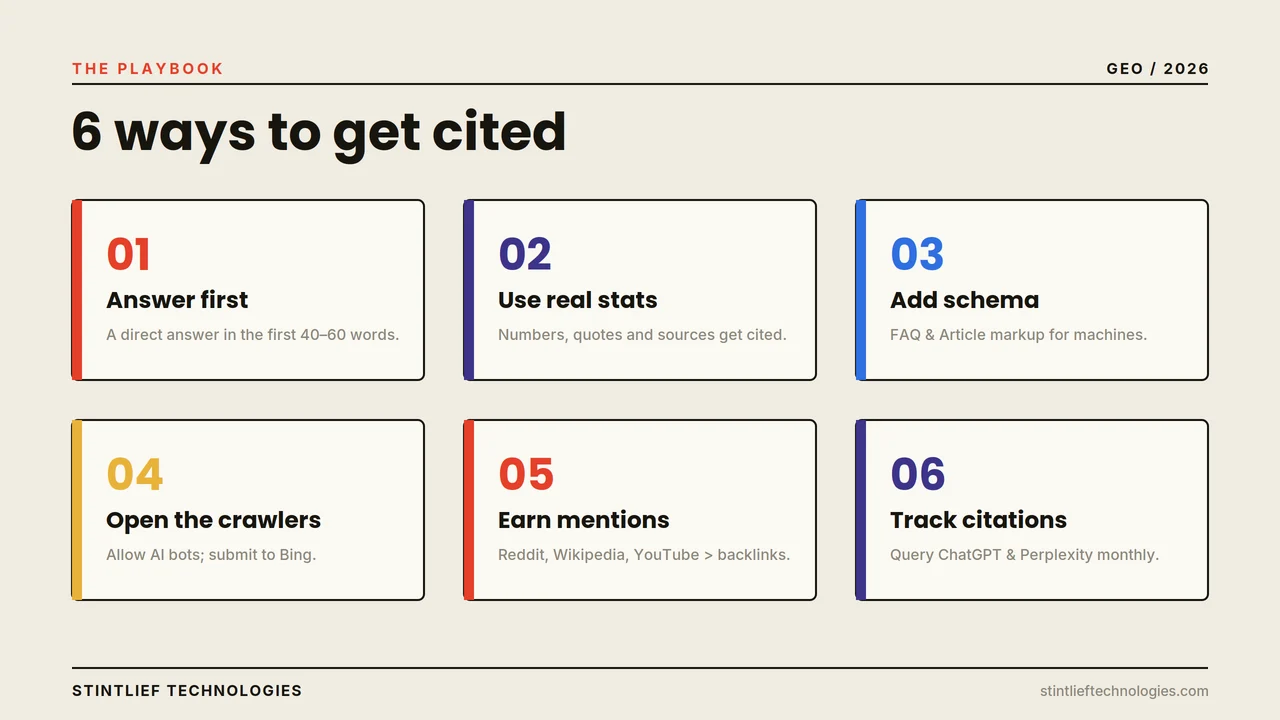
The good news: getting cited is learnable, and it rewards good content over tricks. Here are eight practical steps, in the order we’d tackle them.
This guide is the action plan; if you want the background on how AI-era search differs from the old model, start with our companion piece on AEO vs SEO, then come back here to execute.
1. Answer the question in the first two lines
AI engines pull short, self-contained answers from your content. If the reader has to wade through three paragraphs of throat-clearing before you get to the point, the AI won’t wait either.
Lead every important page and section with a direct, complete answer in the first 40 to 60 words, then expand below it. Put the “what” and the “how much” up top; save the story for later. This single habit does more for AI visibility than almost anything else, because it hands the engine exactly the extractable snippet it’s looking for.
2. Put real numbers and sources in your content
This is the finding that surprised everyone. The original Princeton-led GEO research tested thousands of queries and found that the tactics that actually lift AI visibility are adding statistics, quoting sources, and citing references, some of them boosting visibility by up to 40%. Keyword stuffing, the old SEO reflex, performed worse than doing nothing.
The lesson is simple: vague claims get ignored, specific ones get cited. “We improve conversions” is invisible. “Clients saw a 47% lift after we rebuilt their checkout” is quotable. Use real figures, name your sources, and lean on first-party data from your own projects, because that’s the stuff no competitor can copy.
3. Add FAQ and Article schema
Structured data is how you spell out, in a language machines read cleanly, what your page is and what questions it answers. FAQPage and Article schema in particular make your content easy for AI engines to parse and lift.
If your site runs on WordPress, an SEO plugin like RankMath or Yoast lets you add these without touching code. Mark up your FAQ sections and your articles, keep your published and updated dates visible, and you remove a lot of the guesswork the engine would otherwise have to do.
4. Let the AI crawlers in, and get into Bing
You can’t be cited if the engines can’t read you. Two quick technical checks matter here.
First, make sure your robots.txt isn’t blocking AI crawlers like GPTBot and others, unless you’ve deliberately chosen to. Many sites block them by accident and quietly vanish from AI answers. Second, submit your sitemap to Bing Webmaster Tools, because ChatGPT’s web search leans on Bing’s index, and a lot of businesses obsess over Google while ignoring the index that actually feeds the biggest AI engine.
5. Write the way people ask AI
Search keywords were short and clipped: “web developer noida.” AI questions are long and natural: “who’s a good web development company in Noida for a startup app?” The research shows AI answers are far more likely to appear on longer, conversational queries than on two-word ones.
So write in that register. Use real questions as headings, answer them plainly, and cover the specific, long-tail versions of what your customers actually ask out loud. This also happens to make your content more useful to humans, which is the point.
6. Build your brand’s mentions beyond your own site
Here’s a genuine change from classic SEO. For AI visibility, being mentioned across the wider web, on Reddit, YouTube, Wikipedia, industry roundups and credible listicles, now influences whether you get cited more than raw backlinks do. Reddit in particular is one of the most-cited sources across the major AI engines.
You can’t fake this, and you shouldn’t try, since AI systems are getting good at detecting astroturfed reviews and fake mentions, and the trust penalty isn’t worth it. What works is being genuinely present and genuinely useful where your audience already talks. It’s the same instinct behind our guide to getting your first 1,000 customers: show up where the conversation is, and be worth mentioning.
7. Strengthen your credibility signals
AI engines try to cite sources they can trust, and they look for the same signals a careful human would. Put a real, named author with a short bio on your content. Show clear published and updated dates. Reference your sources inline. Keep an “About” and contact presence that makes it obvious a real, accountable business stands behind the site.
This is doubly important in India, where a lot of business sites are thin and anonymous. A site that clearly signals a real team, real expertise and real recency stands out to both readers and engines, and it ties directly to the credibility problems we covered in 5 signs your website is costing you clients.
8. Track your citations, then repeat what works
You can’t improve what you don’t measure, and GEO is harder to track than SEO because a zero-click answer sends no visitor. So measure it directly.
Once a month, run your 20 or 30 most important customer questions through ChatGPT, Gemini and Perplexity, and note where you’re cited and where a competitor is instead. That list is your scoreboard. Fix the pages losing to competitors, double down on the topics where you’re already winning, and give it time, because there’s typically a four-to-eight-week lag between publishing and showing up in AI answers.
What not to do
A short warning, because the shortcuts backfire. Don’t keyword-stuff; it actively hurts AI visibility. Don’t buy fake reviews or pay for sockpuppet mentions; detection is good and the trust collapse costs more than you’d gain. And don’t abandon SEO to chase GEO. Traditional search still drives far more traffic today; the winning approach in 2026 runs both, with SEO for volume and AI search optimization for high-intent, high-converting visibility.
Get these eight right and you’re not gaming anything. You’re making your business the clear, credible, well-structured source that AI engines want to cite, which is exactly the business customers want to hire.
At Stintlief, we build and optimise sites to be found by both people and AI engines. If your business is invisible when customers ask AI, the most useful starting point is a quick audit of where you’re cited today, and where your competitors are showing up instead.
Frequently asked questions
What is AI search optimization?
AI search optimization, also called Generative Engine Optimization (GEO), is the practice of structuring your content so AI engines like ChatGPT, Google AI Overviews, Gemini and Perplexity cite it as a source inside their answers, rather than just ranking it as a blue link.
How is AI search optimization different from SEO?
Traditional SEO earns rankings and clicks; AI search optimization earns citations inside AI-generated answers. There’s now little overlap between the pages that rank on Google and the ones AI engines cite, so the two need related but distinct tactics.
How do I get cited by ChatGPT?
Lead pages with a direct answer, include real statistics and cited sources, add FAQ and Article schema, allow AI crawlers, submit your sitemap to Bing (ChatGPT uses Bing’s index), and build genuine brand mentions across the web. Expect a four-to-eight-week lag.
Does AI search optimization replace SEO?
No. Traditional search still drives far more traffic today. The best 2026 strategy runs both: SEO for organic volume, and AI search optimization for high-intent, high-converting visibility inside AI answers.
Is AI search traffic actually worth it?
Yes, disproportionately. Although AI still sends a small share of total visitors, studies through 2025 and 2026 found AI-referred visitors converting many times better than organic ones, because they arrive with a specific question and a forming shortlist.
How do I measure if AI search optimization is working?
Run your most important customer questions through ChatGPT, Gemini and Perplexity each month and record where you’re cited versus competitors. Track AI referrers in your analytics too. That citation scoreboard, over time, tells you what’s working.
Stintlief Technologies builds and optimises websites to be found by people and AI engines alike, for businesses across India. If customers can’t find you in AI search, get in touch.