

Ask any Indian business owner where their customers actually are, and the honest answer is WhatsApp. Not email, which goes unread. Not SMS, which died for anything that isn’t an OTP. WhatsApp, where people already spend a chunk of their day and happily reply to a business the same way they reply to a friend.
For years that was a missed opportunity, because most businesses used WhatsApp the manual way: one person, one phone, typing replies until their thumbs gave out. That does not scale, and it definitely does not sell at 11pm. The WhatsApp Business API changed that, and in 2026, with AI now built directly into the platform, it has quietly become one of the most effective sales channels an Indian business can have.
Here is what that actually means, minus the vendor sales pitch.
First, the API is not the app
There are three versions of WhatsApp for business, and mixing them up causes most of the confusion.
Regular WhatsApp is what everyone has on their phone. Fine for a friend, useless for a business at any real volume.
The WhatsApp Business app is the free version with a catalogue, quick replies and away messages. Good for a very small shop run off one phone.
The WhatsApp Business API is the version built for scale. It has no app of its own. Instead it plugs WhatsApp into your other software, your CRM, your website, your AI, so messages can be sent, received, automated and tracked by systems rather than a person tapping a screen. This is the one that lets you handle thousands of conversations, send order updates automatically, take payments in the chat, and put an AI agent on the front line. When people talk about serious WhatsApp automation in 2026, this is what they mean.
You don’t access the API directly from Meta in most cases. You go through a Business Solution Provider, and in India there is a healthy market of them. That’s the plumbing. What matters is what you can now do with it.
What changed in 2026: AI moved into the chat
The big shift this year is that AI stopped being something you bolted onto WhatsApp and became part of the platform itself.
In June 2026, Meta made its own Meta Business Agent available globally inside WhatsApp, after roughly two years of testing it in markets including India. Out of the box it can answer customer questions, recommend products, book appointments, qualify sales leads, and hand a conversation to a human when it gets out of its depth. That is Meta’s basic, free-tier version, and for a micro-business answering simple FAQs it is a reasonable start.
For anything more serious, the real power is in connecting a proper AI agent through the API. And there is a genuine difference between the two, which brings us to the distinction that matters most.
Chatbot vs AI agent: the difference that decides everything
Most businesses that tried WhatsApp automation before 2025 used a rule-based chatbot, and most of them were disappointed. There is a good reason for that.
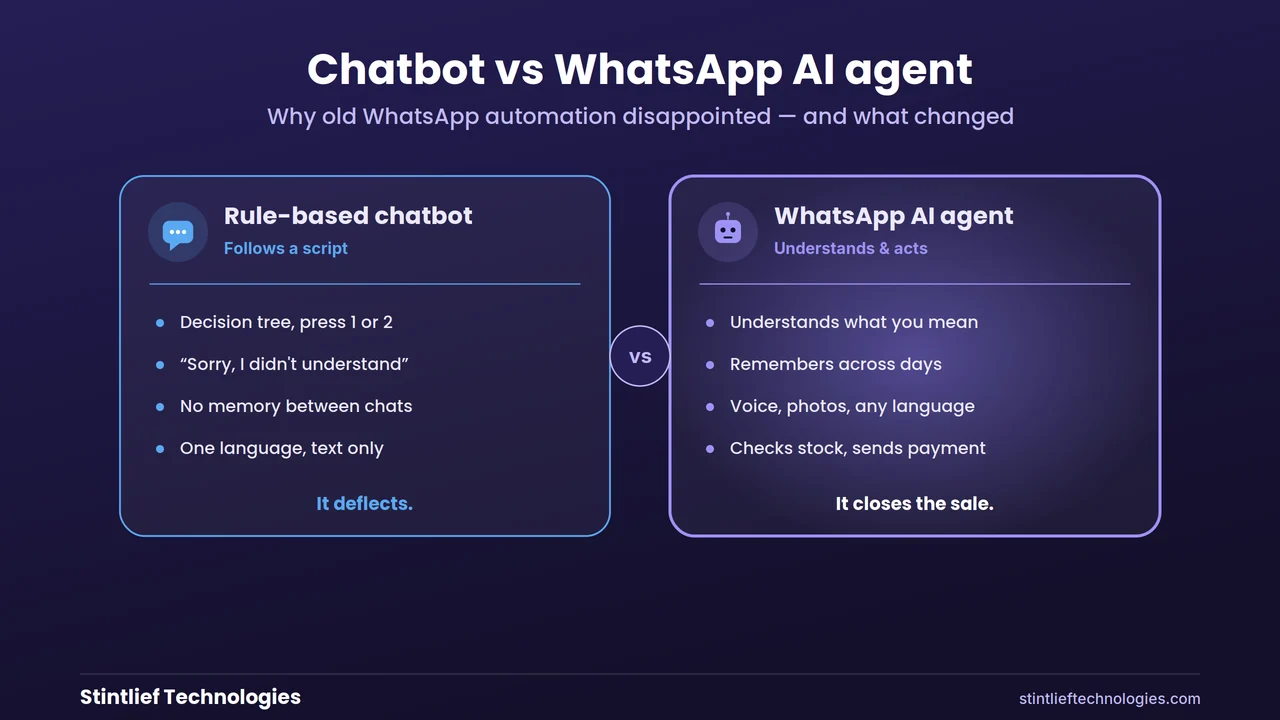
A rule-based chatbot follows a decision tree. Press 1 for sales, press 2 for support. The moment a customer types something the tree didn’t anticipate, it falls back to “sorry, I didn’t understand that,” and the customer gives up. It has no memory, no flexibility, and it feels robotic because it is.
A WhatsApp AI agent, powered by a large language model, behaves completely differently. It understands what the customer actually means rather than matching keywords. It remembers the conversation across days, not just the current session. It handles voice notes and photos, which matters enormously in India where customers often send a picture or a voice message rather than typing. It switches between Hindi, English and regional languages mid-conversation without being reconfigured. And crucially, it does things: checks your live inventory, pulls the customer’s order history, shares a payment link, books the slot. This connects directly to the ideas in our guide on AI agents for business, applied to the one channel your customers already live in.
The practical gap shows up in the numbers businesses report: first response times dropping from hours to under a minute, and far more conversations resolved without a human ever stepping in. When your competitor replies next morning and your AI agent replied, in Hindi, within thirty seconds and already sent a payment link, you can guess who got the sale.
Why this fits India specifically
WhatsApp automation is useful everywhere, but it is close to essential in India, for reasons that are structural rather than hype.
The scale is unmatched. India has well over half a billion WhatsApp users, and people open it many times a day, not occasionally. It is not one channel among many here. It is the channel.
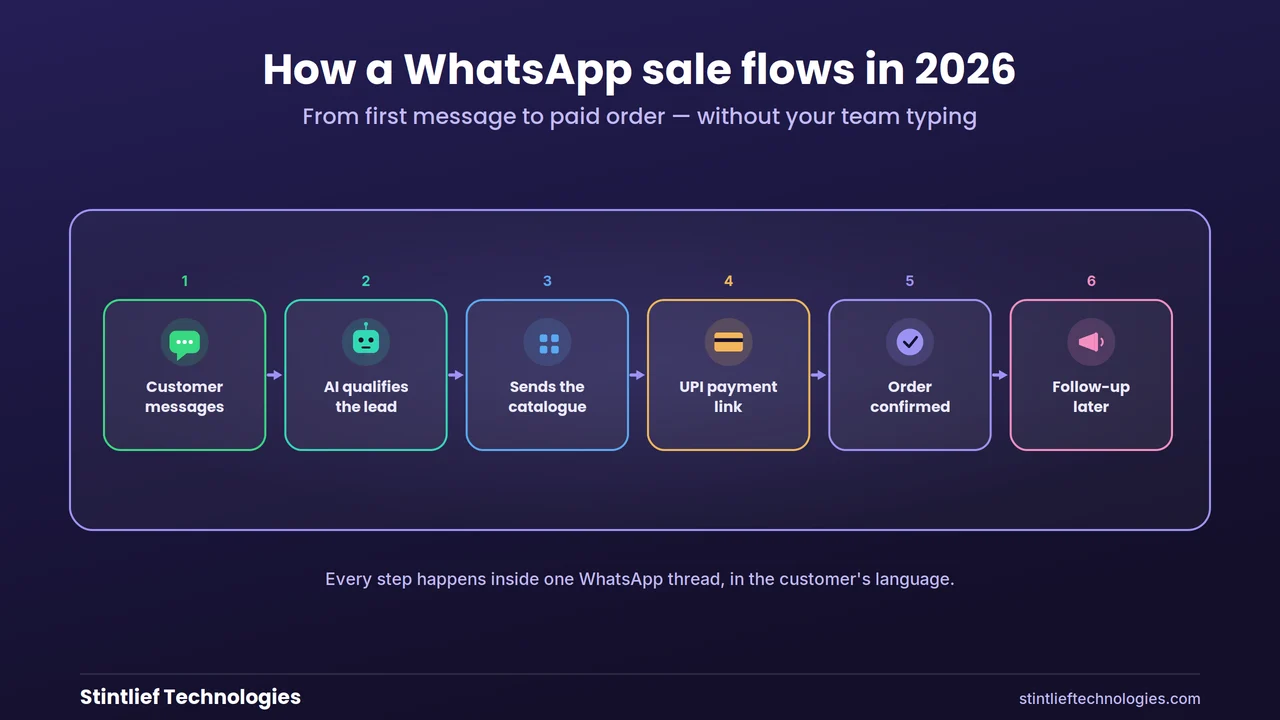
Payments close inside the chat. This is the quiet game-changer. With UPI, a customer can receive a payment link and pay without ever leaving the conversation. Voice can open a conversation and build trust, especially in a regional language, and WhatsApp closes the loop with the payment link, the order acknowledgement, the KYC document upload. That full loop, from first message to paid order, happening in one thread, is something no other channel does as smoothly. It pairs naturally with the customer-acquisition tactics we covered in getting your first 1,000 customers.
Language is not an afterthought. An AI agent that handles 22 Indic languages natively reaches customers a English-only funnel simply cannot.
What you can actually build
To make this concrete, here is what a well-set-up WhatsApp API system does for a typical Indian business.
It answers instantly, at any hour, in the customer’s language. It shows your product catalogue inside the chat and lets people browse and pick. It sends a UPI payment link and confirms the order the moment payment lands. It fires order and delivery updates automatically, cutting the “where is my order” messages that eat your team’s time. It re-engages people who went quiet, and it recovers abandoned carts with a gentle nudge. It qualifies leads and only passes the serious ones to a human. And it logs every conversation into your CRM so nothing lives on a personal phone that walks out the door when an employee leaves.
None of this requires your team to sit and type. That is the point.
The rules and costs you should know
A quick honest section, because WhatsApp is not a free-for-all and setup done wrong gets you blocked.
You need opt-in. Under Meta’s rules and India’s TRAI regulations, you can only message people who have agreed to hear from you. Buying a list and blasting it is the fastest way to lose your number.
Templates are approved in advance. Any message you start (as opposed to replying within a conversation) uses a pre-approved template. This keeps the channel clean, and it is why setup matters.
Pricing is per message and varies by type. Meta charges based on the kind of conversation, and the rates differ for marketing, utility and service messages. It is affordable at scale, but you should model it against your volumes rather than assume it is free. A provider or development partner can size this for you.
The tone still matters. An AI agent that feels pushy or spammy will get muted or reported. The businesses that win treat WhatsApp as a helpful, welcome channel, not another place to shout offers.
How to start without getting it wrong
You do not need to build everything at once. The sensible path is staged.
Start with the API through a reputable provider and get your number verified properly. Then automate the highest-volume, most repetitive messages first, usually order updates and the top handful of customer questions. Add the AI agent once that foundation is stable, beginning with it drafting replies for a human to approve before you let it respond on its own. Connect it to your catalogue and payments so conversations can actually close. And wire everything into your CRM from day one, so the data is yours.
The mistake we see most often is businesses jumping straight to a fancy AI agent on a shaky foundation, with no opt-in strategy and no CRM behind it. Get the plumbing right first. The intelligence sits on top of it.
At Stintlief, we build these WhatsApp systems end to end, from API setup and CRM integration to the AI agent that runs the conversations. If you are trying to work out whether this fits your business, the most useful starting point is a quick look at where your customer conversations currently happen and how many you are losing simply because nobody replied in time.
Frequently asked questions
What is the WhatsApp Business API? It is the version of WhatsApp built for scale. Unlike the free WhatsApp Business app, the API has no interface of its own; it connects WhatsApp to your other software so messages can be automated, tracked, and handled by systems and AI rather than a person typing on a phone.
What is the difference between the WhatsApp Business app and the API? The app is free and made for very small businesses run from a single phone. The API is for businesses that need to handle high message volumes, automate replies, take payments in the chat, integrate a CRM, and run an AI agent.
Can WhatsApp handle payments in India? Yes. Through UPI, a business can send a payment link inside the chat and the customer can pay without leaving the conversation, which lets the entire journey from enquiry to paid order happen in one thread.
What is a WhatsApp AI agent? It is an AI, powered by a large language model, that handles WhatsApp conversations. Unlike a rule-based chatbot, it understands meaning, remembers context across days, handles voice and images, switches languages, and can take actions like checking stock or sending a payment link.
Is WhatsApp automation allowed under Indian rules? Yes, within the rules. You need customer opt-in, and business-initiated messages must use pre-approved templates. Meta’s policies and India’s TRAI regulations govern this, so setup needs to be done correctly to avoid your number being blocked.
How much does the WhatsApp Business API cost? Meta charges per conversation, with different rates for marketing, utility and service messages. It is cost-effective at scale, but the total depends on your message volumes and types, so it is worth modelling before you commit.
How do I get started with the WhatsApp Business API? Set up the API through a reputable provider, verify your number, automate your highest-volume messages first, then add an AI agent connected to your catalogue, payments and CRM. Starting with human-approved replies before full automation keeps it safe.
Stintlief Technologies builds WhatsApp automation, AI agents and custom software for businesses across India. If you want to explore turning WhatsApp into a sales channel, get in touch.