

Every Indian business owner knows the sound of a missed opportunity. It’s the phone ringing while the one person who answers it is already on another call. It’s the customer who rang at 9pm, got no answer, and rang your competitor at 9:01. It’s the “press 1 for sales, press 2 for support” menu that everyone hates and half of callers abandon.
The phone is still where a huge amount of Indian business happens. People trust a voice, especially in their own language, in a way they don’t trust a form or a cold SMS. But answering every call, at every hour, in every language, has always been expensive and impossible to do well.
That is the problem AI voice agents are quietly solving in 2026, and this is the year the technology finally became good enough to trust with a real conversation.
What an AI voice agent actually is
Let’s be clear about what we’re talking about, because it is not the robotic phone menu you’re picturing.
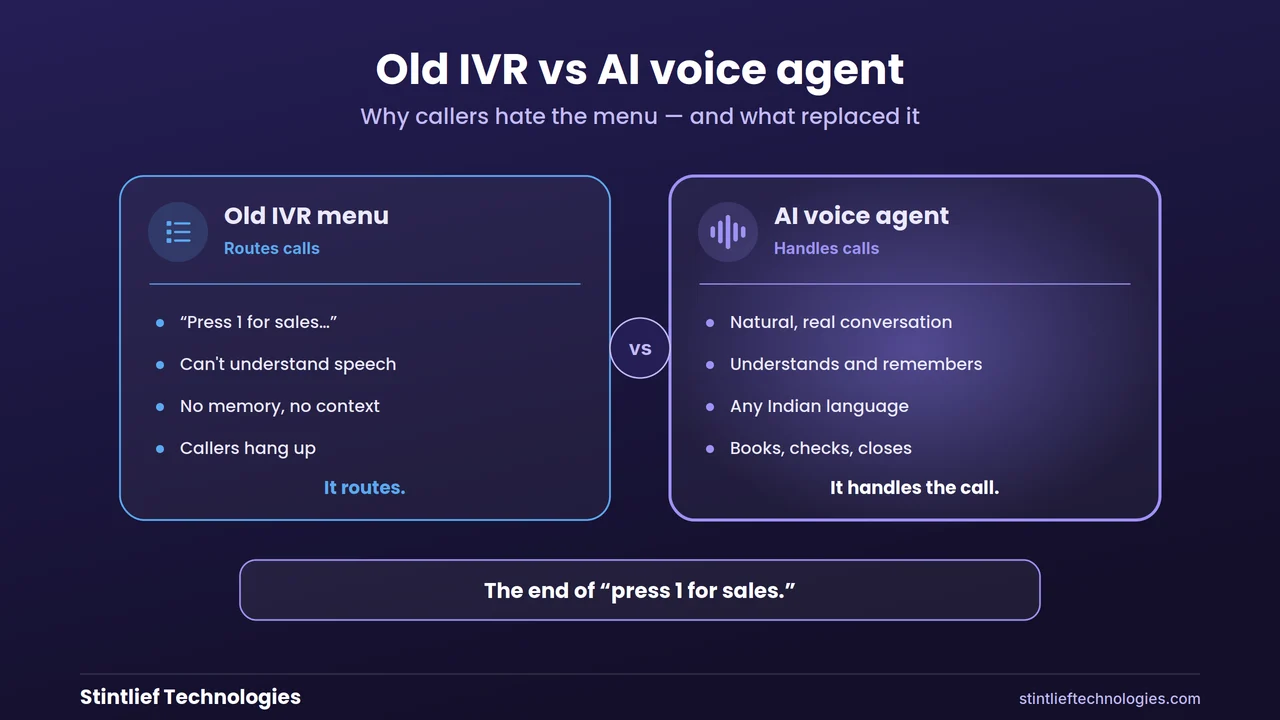
An old IVR system, the “press 1, press 2” menu, follows a rigid tree. It can’t understand anything you say; it can only route you. If your question doesn’t fit a numbered option, you’re stuck.
An AI voice agent is a different animal. It’s an AI, powered by a large language model with natural speech, that actually holds a conversation on the phone. You speak normally, it understands what you mean, and it responds in a natural voice, in the language you’re speaking. More importantly, it does things: it checks your order status in real time, books the appointment into the calendar, qualifies the lead and passes only the serious ones to a human, and answers the questions your team gets asked fifty times a day. It’s the same agentic shift we covered in our guide on AI agents for business, except it works over a phone call instead of a chat window.
The short version: the old system routed calls. The new one handles them.
Why 2026 is the turning point
AI could technically “talk” for a few years, but it was awkward. There was a lag before it replied, the voice sounded flat, and it stumbled over accents and mixed languages. On a phone call, where people expect an instant, natural back-and-forth, that was enough to make it useless.
Two things changed. The models got fast enough to reply in near real time, so the uncomfortable pause disappeared, and the voices became genuinely natural. And critically for India, they got good at regional languages and at the code-switching between English and Hindi that real Indian conversations are full of. Once the delay and the robotic voice went away, the experience crossed the line from irritating to actually helpful.
The market noticed. By most estimates, the large majority of customer service teams will be using some form of generative AI by the end of 2026, and a striking share of customers now say a well-trained AI resolves their issue faster than waiting for a human. Younger customers, in particular, increasingly prefer talking to a capable AI over sitting in a hold queue.
Why this fits India especially well
Voice automation is useful everywhere, but it lines up unusually well with how India actually does business.
Voice is the high-trust opener here. Indians will pick up a phone call, especially one in Hindi or their regional language, at far higher rates than they’ll open a promotional SMS or a cold email. A call in the right language gets answered when nothing else does.
Language coverage is now real, not tokenistic. The better platforms handle a wide range of Indian languages natively, so a single agent can greet one caller in Tamil and the next in Punjabi without being reconfigured. For a country where English-only funnels miss most of the market, that’s the whole game.
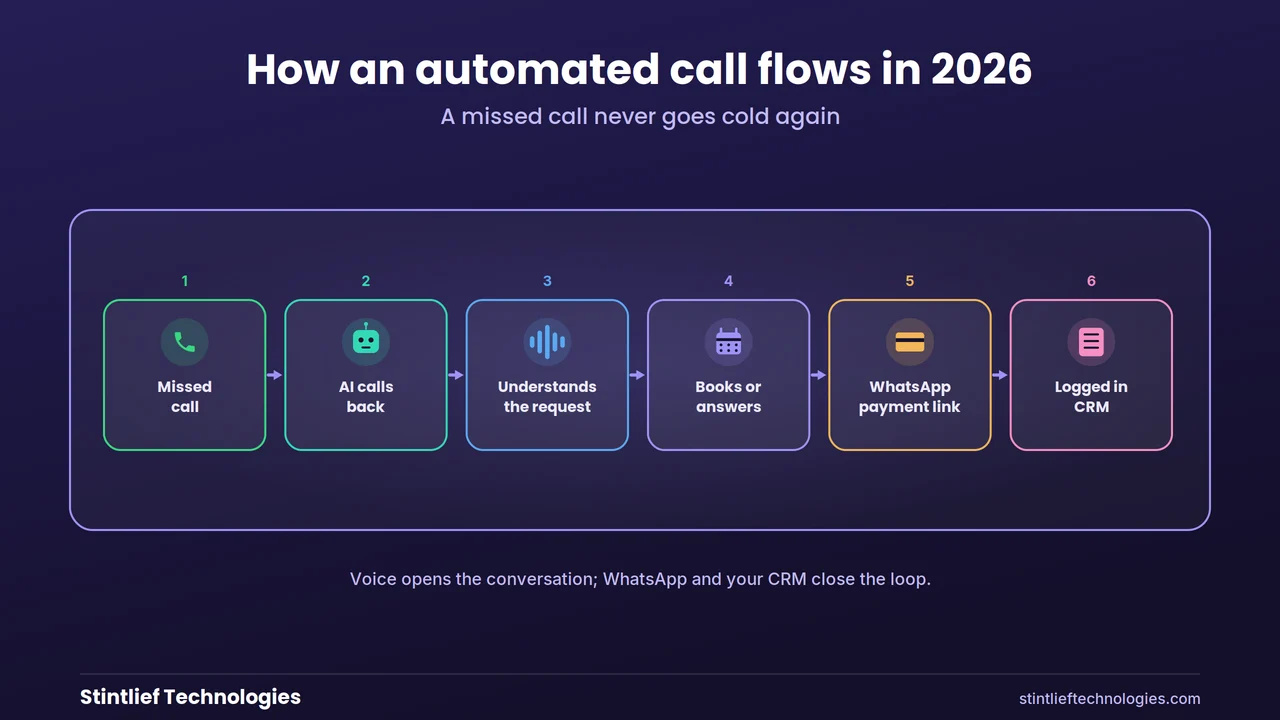
And voice pairs beautifully with WhatsApp. This is the combination we keep seeing work: the voice agent opens the conversation and builds trust, then hands off to WhatsApp to finish the transactional part, the payment link, the order confirmation, the document upload. A caller can be on the phone and watch the UPI payment link land on WhatsApp before they’ve hung up. If you want the other half of that story, it’s in our piece on the WhatsApp Business API. Together, voice and WhatsApp cover the entire journey from first ring to paid order.
Where businesses are actually using them
To keep this concrete, here’s where AI voice agents earn their keep for a typical Indian business.
Answering inbound calls around the clock, so nobody who rings at night hits a dead line. Qualifying leads by asking the right questions and routing only the serious buyers to your sales team. Booking and rescheduling appointments directly into the calendar, which alone saves clinics, salons and service businesses hours a day. Handling the endless “where is my order” and “what are your timings” calls that clog your lines. Making outbound reminder calls for appointments, renewals and payments, in the customer’s language. And the very Indian classic: turning a missed call into an instant automated callback, so a lead never goes cold because nobody was free.
None of this replaces your best people. It removes the repetitive, after-hours, high-volume calls that were burning them out and being dropped anyway.
The honest limitations
This is the part the vendor demos skip, and it’s the part that decides whether a deployment works or embarrasses you.
The conversation can still slip. On a complex or emotional call, an AI voice agent can misread the situation. That’s why every good setup has a clean, fast handoff to a human, and why you should never put a fully automated agent in front of a genuinely sensitive call, a complaint, a medical concern, a distressed customer, without a person ready to step in.
Accents and noise are real. It handles most callers well, but a heavy accent on a bad line will still trip it up sometimes. Set expectations accordingly and monitor the calls it struggles with.
Disclosure and consent matter. Customers should know they’re speaking to an AI, and outbound calling in India is governed by TRAI rules around consent and timing. Cutting corners here damages trust and can get your numbers blocked. Do it properly.
And tone is everything on a call. A voice agent that feels pushy or scripted is worse than no agent at all. The ones that work sound helpful and human, and know when to gracefully hand over.
How to start without a disaster
You don’t switch your whole phone line over on day one. Start narrow.
Pick one high-volume, low-risk call type first, usually order-status questions, appointment booking, or after-hours answering. Deploy the agent in your customers’ primary language, and add others as you see the mix of who calls. Keep a human handoff wired in from the start, and listen to a sample of real calls every week to catch where it’s failing. Connect it to your calendar, your order system and your CRM so it can actually do things and log every call. And measure something concrete: calls answered after hours, appointments booked, leads qualified, missed calls recovered. If the number moves, expand. If it doesn’t, fix the use case before you widen it.
The mistake we see is businesses trying to automate every call at once, with no human backup and no measurement, then concluding “AI doesn’t work” when really the rollout was wrong. Start with one job it can do brilliantly.
At Stintlief, we build these voice systems end to end, from the agent and its languages to the calendar, CRM and WhatsApp integrations that let it close the loop. If you’re wondering whether this fits your business, the most useful starting point is a quick look at how many calls you’re currently missing, and what those missed calls are worth.
Where this is heading
The direction is clear. Voice, chat and web are merging into one continuous conversation, so a customer can start on a call, continue on WhatsApp, and finish on your website without repeating themselves, because the agent remembers the whole thread. Voices are getting more natural, languages more complete, and the cost per call keeps falling.
For an Indian business, the opportunity right now is the early one. Most of your competitors are still letting calls ring out or hiding behind a menu everyone hates. An AI voice agent that answers instantly, in the caller’s language, and actually gets something done, is the kind of difference customers remember, and tell people about.
Frequently asked questions
What is an AI voice agent? An AI voice agent is an AI that holds real phone conversations using natural speech. Unlike an old IVR menu, it understands what callers mean, replies in a natural voice in their language, and takes actions like booking appointments, checking orders or qualifying leads.
How is an AI voice agent different from an IVR? An IVR follows a fixed “press 1, press 2” menu and can only route calls. An AI voice agent understands free-form speech, holds a natural back-and-forth, remembers context, and completes tasks rather than just directing the caller to a department.
Can AI voice agents speak Indian languages? Yes. The better platforms handle a wide range of Indian languages natively and can even switch between English and Hindi mid-conversation, so one agent can serve callers across regions without being reconfigured for each language.
Will an AI voice agent replace my call centre staff? It replaces the repetitive, high-volume and after-hours calls, not your best people. Complex, sensitive or emotional calls should still go to humans, which is why every good setup includes a fast handoff from the agent to a person.
Is automated calling legal in India? Business calling in India is governed by TRAI rules around consent and timing, and customers should be told they’re speaking to an AI. Done within those rules, with proper opt-in for outbound calls, it’s fine; cutting corners risks your numbers being blocked.
How much does an AI voice agent cost? Costs depend on call volume, languages and the integrations you need. A single-use-case agent, such as after-hours answering, is a modest project, while a full multi-language system wired into your CRM and WhatsApp is a larger build. It’s best scoped against the value of the calls you’re currently missing.
How do I get started with an AI voice agent? Start with one high-volume, low-risk call type in your main language, keep a human handoff in place, connect it to your calendar, order system and CRM, and measure a concrete result before expanding. A development partner can help you scope and integrate the first use case.
Stintlief Technologies builds AI voice agents, WhatsApp automation and custom software for businesses across India. If you want to stop losing calls, get in touch.