

Digital MarketingSEO
Something changed in how people search, and most businesses have not caught up yet.
AEO vs SEO is the conversation that every marketing team needs to have in 2026 — not because SEO is dead (it isn’t), but because the way users find information has split into two distinct tracks. One track still runs through Google’s search results page. The other skips the results page entirely and gets an answer synthesised directly by ChatGPT, Perplexity, Google AI Overviews, or Gemini.
If your content only shows up in the first track, you are invisible on the second. And the second track is growing fast.
At Stintlief, we handle digital marketing for clients across India. The AEO vs SEO question started coming up in conversations about 12 months ago, tentatively at first. Now it comes up in nearly every strategy discussion. This is our honest read on what the distinction actually means, what you need to do differently, and — importantly — what you do not need to throw away.
What Is AEO (Answer Engine Optimization)?
Answer Engine Optimization (AEO) is the practice of structuring your content so that AI-powered platforms can extract it, understand it, and deliver it as a direct answer to a user’s question.
If traditional SEO is about ranking in search results, AEO is about becoming the answer itself.
When someone types “best app development company in Noida” into ChatGPT or Perplexity, those platforms do not show them a list of ten blue links. They synthesise a response from multiple sources and cite the ones they trust. AEO is the discipline of getting your content into that synthesis — being one of the two or three sources cited in the final answer.
The answer engines that matter in 2026:
- ChatGPT — over 400 million weekly active users, now processing more than 2 billion queries daily, with 65% qualifying as search-intent queries
- Google AI Overviews — appearing in roughly 60% of Google searches, reaching nearly a billion searchers
- Perplexity — growing fastest among research-heavy users, runs its own web crawler (PerplexityBot)
- Microsoft Copilot — integrated into Windows and Microsoft 365, substantial enterprise reach
- Google Gemini — increasingly integrated into Google Search and Google Workspace
AEO vs SEO: The Core Difference
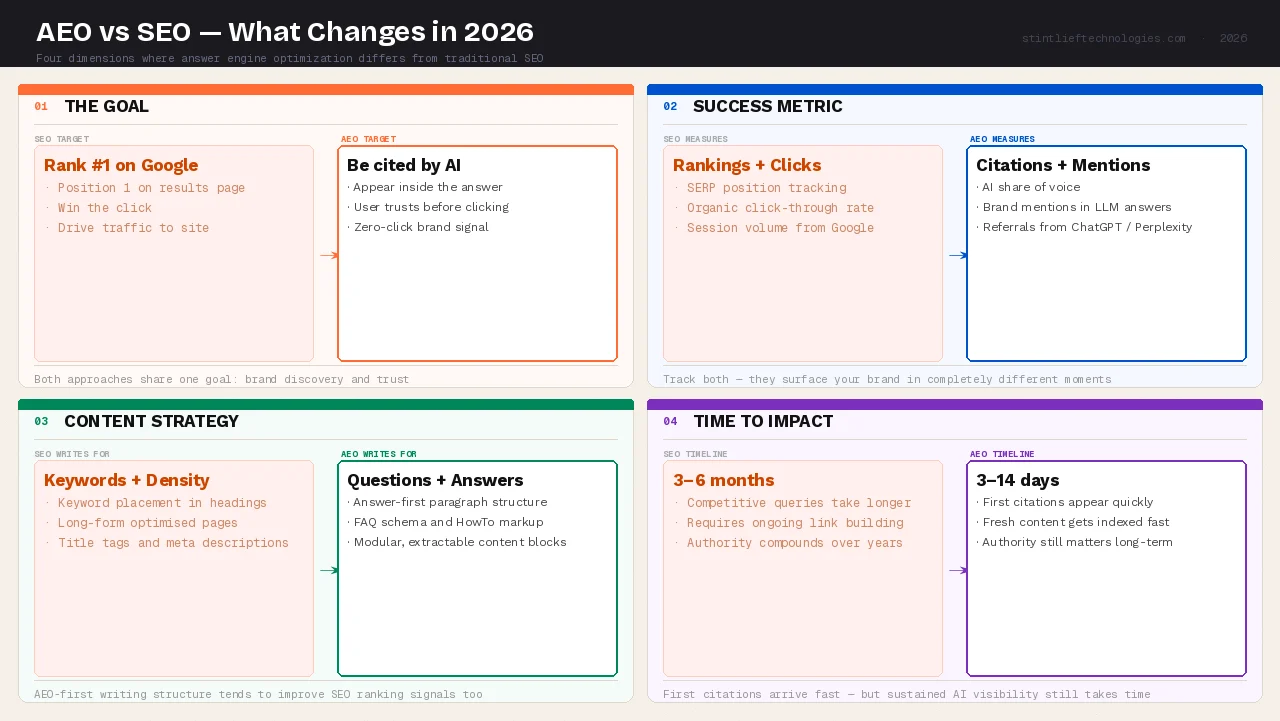
The simplest way to put it: SEO gets you ranked. AEO gets you cited.
In traditional SEO, the goal is Position 1 on Google’s results page. The user sees your link, clicks it, lands on your site. Success is measured in impressions, clicks, and traffic.
In AEO, the goal is to be the source that the AI cites when it builds an answer. The user may never click your link. They may read the AI’s synthesis and move on. But your brand was mentioned as the authority. That builds trust before they ever visit your site — and when they do eventually visit, they arrive pre-qualified.
| Factor | SEO | AEO |
|---|---|---|
| Goal | Rank #1 on Google | Be cited as a source by AI |
| Platform | Google, Bing search results | ChatGPT, Perplexity, AI Overviews |
| Success metric | Rankings, clicks, traffic | Citations, brand mentions, share of voice |
| User action | Clicks through to your site | Gets answer without clicking |
| Content format | Keyword-optimised pages | Structured, extractable, answer-first |
| Speed to impact | 3–6 months | 3–14 days for initial citations |
| Measurement tools | Google Search Console, Ahrefs | Semrush AI, Profound, referral analytics |
This does not mean AEO replaces SEO. The two work differently but depend on each other. AI engines like ChatGPT use Google’s search index to power their answers. Perplexity crawls the web directly. Google AI Overviews pull from Google’s own index — and 38% of AI Overview citations come from pages already ranking in the top 10 organic positions. If your SEO is weak, your AEO will be weak by extension. Strong SEO is the foundation on which AEO is built.
Why AEO Matters for Indian Businesses in 2026
The numbers behind the AEO vs SEO shift are worth sitting with for a moment.
Gartner predicts that traditional search engine volume will drop by 25% by 2026 as users shift to AI chatbots and virtual agents. Google’s worldwide search market share fell below 90% for the first time since 2015. AI-referred sessions to websites grew 527% year-over-year through mid-2025. Roughly 60% of Google searches now end without the user clicking any result — the answer appears directly on the results page.
That last number is the one that changes the business case for content marketing most fundamentally. If six out of ten searchers are getting their answer without clicking, then ranking #1 for an informational query does not deliver the traffic it used to. The value of that ranking has shifted — from driving clicks to establishing credibility that gets cited.
For Indian businesses specifically, the AEO opportunity is real but underutilised. Most Indian businesses have focused their digital investment on traditional SEO, social media, and paid ads. Very few have structured their content to be extractable by AI engines. That means the competition for AI citations in most Indian business categories is currently low — early movers have a genuine advantage that will erode as awareness grows.
How AEO vs SEO Tactics Actually Differ
Understanding the distinction conceptually is one thing. Knowing what to do differently is another.
What stays the same
The foundations of good SEO are also the foundations of good AEO. Technical health — crawlability, site speed, HTTPS, mobile responsiveness — matters for both. Content quality, originality, and expertise matter for both. Backlinks from reputable sources matter for both, because they are how AI engines determine who to trust. E-E-A-T (Experience, Expertise, Authoritativeness, Trustworthiness) applies directly to AEO — AI engines are essentially performing an automated trust assessment when they decide which sources to cite.
What changes for AEO
Answer-first structure. In SEO, you can bury your core answer halfway down a long article because users will scroll. In AEO, the answer needs to be in the first paragraph — often the first sentence. AI engines extract the most directly useful passage from a page. If your answer is buried, it will not be extracted.
Conversational query matching. SEO content targets keyword phrases: “app development company India”. AEO content targets the full question a user asks conversationally: “Which app development company in India is best for fintech startups?” The queries are longer, more specific, and phrased as natural questions. Your content needs to explicitly address those full questions.
Structured data and schema. FAQ schema, HowTo schema, Article schema, and Organisation schema all make your content more legible to AI engines. In 2026, these are not optional nice-to-haves — they are the markup that helps AI engines identify your content as structured, reliable, and extractable.
Modular content blocks. AI engines do not need your entire article. They need one paragraph from it that directly answers the question. Writing content in self-contained blocks — where each section can stand alone as an answer — dramatically increases the chance that a passage gets extracted and cited.
Citation network. AEO rewards brands that are mentioned across trusted third-party sources — industry publications, news sites, directories, review platforms. This is similar to backlinks in SEO but broader: being mentioned (not just linked) on sites that AI engines crawl and trust increases your authority in AI responses.
The AEO vs SEO Measurement Problem
The honest complication in the AEO vs SEO conversation is that AEO is harder to measure — and easier to misattribute.
Traditional SEO metrics are relatively straightforward: rankings, impressions, clicks, and conversion rates from organic traffic. You can see exactly which pages are driving traffic and from which queries.
AEO metrics are murkier. A user who discovers your brand in a ChatGPT response may not click through immediately. They may come back later via branded search, direct navigation, or a referral from someone they told about it. That conversion should be partially credited to AEO, but your analytics will call it direct or branded search.
What you can measure directly in 2026:
- AI referral traffic — visits from chat.openai.com, perplexity.ai, and Bing Copilot show up as distinct referrer sources in Google Analytics
- Citation tracking — tools like Semrush, Profound, and Advanced Web Ranking track how often your brand appears in AI-generated responses
- Share of voice — your citation frequency relative to competitors for your target queries
- Branded search lift — increases in branded searches often signal that AI citations are building awareness that converts later
Google Search Console is still essential for the AEO vs SEO overlap: queries with high impressions but low clicks often indicate your content is appearing in AI Overviews or featured snippets, where users get the answer without clicking through.
What AEO vs SEO Looks Like in Practice: Real Scenarios
Scenario 1: B2B technology buyer
A CTO is evaluating app development partners for a fintech project. They ask ChatGPT: “Which app development companies in Noida have experience with fintech and payment gateway integration?”
ChatGPT synthesises a response citing three or four companies from sources it has indexed. If Stintlief Technologies has published detailed, well-structured content about our fintech development experience — case studies, technical articles, FAQ pages — we have a chance of being cited. If we have not, we will not appear in that conversation regardless of our Google ranking.
Scenario 2: Business owner researching costs
A small business owner asks Perplexity: “How much does it cost to build a food delivery app in India in 2026?”
Perplexity crawls the web, finds pages that directly answer that question in structured, clear language, and cites them in its response. A blog post that leads with a direct cost range, breaks down the factors that affect cost, and includes structured data markup is far more likely to be cited than one that buries the numbers in paragraph seven.
Scenario 3: Zero-click Google search
Someone searches “what is progressive web app” on Google. Google’s AI Overview answers the question directly on the results page using content from three or four sources. The user gets their answer and may not click any link. But they now associate those cited sources with credibility on PWA topics.
How to Start With AEO Without Abandoning SEO
The practical starting point for most businesses is not to build an AEO strategy from scratch but to audit and restructure existing content for AEO extractability. The effort is lower than you might expect because the changes are mostly structural, not from-scratch creation.
Step 1: Identify your highest-value question topics. For each service or product area, list the questions a potential customer would ask an AI assistant about it. These are your AEO targets. For a development agency like Stintlief, that might be: “How much does it cost to build a mobile app in India?” or “What is the best tech stack for a food delivery app?”
Step 2: Restructure existing content for direct answers. For each piece of existing content that addresses those questions, move the core answer to the first paragraph. Make sure the answer is self-contained enough to stand alone if extracted. Add FAQ sections that directly mirror the questions users are asking.
Step 3: Add structured data markup. Implement FAQ schema on pages with question-and-answer content. Use Article schema for blog posts. Use Organisation schema on your homepage and contact page. These are not guaranteed to boost AI citations but they reduce friction for AI engines that are trying to categorise your content.
Step 4: Build third-party citations. Get your brand mentioned on industry publications, review platforms, and authoritative directories. Guest posts on credible sites. Press coverage where possible. These third-party mentions are the citation network that AI engines use to assess your authority.
Step 5: Track AI referral traffic. Set up monitoring for referral visits from AI platforms in your analytics. Start tracking branded search volume as a proxy metric for AI-driven brand awareness.
The Honest Reality: AEO Is Still Early
There is something worth saying plainly about the AEO vs SEO debate that most articles skip: AEO measurement is genuinely immature. We do not yet have the same quality of data about what drives AI citations that we have about what drives Google rankings after 25 years of SEO research.
There are fake case studies. There is misattribution — when LLM traffic grows 50% because the platforms are growing (not because your optimisation worked), you can easily credit your AEO work as the cause. There is hype. A lot of what is being sold as “AEO strategy” right now is repackaged SEO with different vocabulary.
What we are confident about at Stintlief, based on what we are actually seeing across client work:
Content that is structured to answer specific questions clearly and immediately does get cited by AI engines. Publications with strong domain authority get cited more frequently than those without. Brands with consistent messaging across their own site and third-party sources appear more reliably in AI responses. Schema markup reduces friction. And SEO fundamentals remain the prerequisite — you cannot optimise for AI citation without a crawlable, trustworthy, well-structured site underneath.
The businesses that treat AEO as a parallel discipline to SEO — not a replacement, not a fad — are the ones building the right kind of visibility for 2026 and beyond.
If you are working through what an AEO vs SEO strategy should look like for your business, talk to Stintlief Technologies. We handle digital marketing for businesses across India and can help you assess where your current content sits and what changes will have the most impact on AI visibility.