

Every few months, someone publishes a headline that sends a wave of panic through developer communities. “AI will replace programmers by 2026.” We have heard versions of this since 2022. And yet, here we are.
The anxiety is understandable. GitHub Copilot writes functions. ChatGPT debugs code. Claude generates entire components from a single sentence. If you have not used these tools yet, the demos look genuinely alarming. But if you actually work with them daily, you start seeing a very different picture.
Let’s cut through the noise.
Where the hype comes from
A lot of the “AI will replace developers” narrative is driven by people who do not write software for a living. Investors, journalists, and tech optimists see demos of AI generating a to-do app in 30 seconds and extrapolate wildly. The problem is that building a to-do app is not the job.
The job is understanding a client’s vague requirements and turning them into something that actually works at scale. It is debugging why a payment gateway fails silently for 0.3% of users in a specific geography. It is deciding whether to refactor a five-year-old codebase or rebuild from scratch, and then living with the consequences either way.
AI is very good at the parts of development that look like development. It struggles with the parts that actually are development.
This distinction matters. Writing syntactically correct code is a small fraction of what developers do. The rest is judgment, context, communication, and problem-solving in environments where requirements shift mid-project and documentation is either wrong or nonexistent.
What AI actually does well
To be fair, the tools are genuinely impressive right now. Anyone saying otherwise is not paying attention. Here is what AI handles well in a real development workflow:
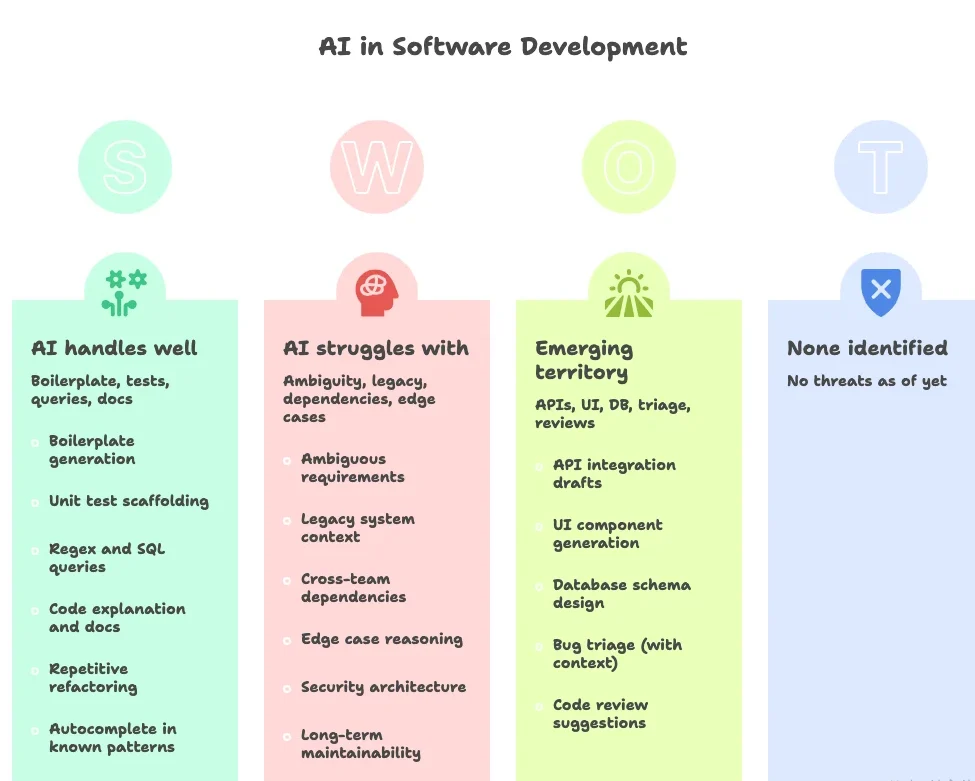
At Stintlief, we use AI tools across our development workflow, and the speed gains are real. A feature that might take three hours to scaffold now takes forty-five minutes. But that scaffolding still needs a developer to review it, integrate it, test it against the actual system, and adjust it when the AI has made confident-sounding but subtly wrong assumptions, which happens more than the demos suggest.The “junior developer” parallel
The most honest framing we have seen is this: AI today is like having a very fast, very confident junior developer who has read every Stack Overflow post ever written but has never shipped anything to production.
That person is genuinely useful. They can get things done. But you would not put them in a room alone with a client, a deadline, and a production database. They need supervision, context, and someone who can catch the mistakes that look right on the surface.
This is exactly the dynamic with AI coding tools right now. The output is often good. But it requires someone with enough experience to know when it is subtly wrong, and those subtle errors in software are the expensive ones.
How the developer role is actually changing
Here is the more realistic picture: AI is not replacing developers. It is changing what developers spend their time on.
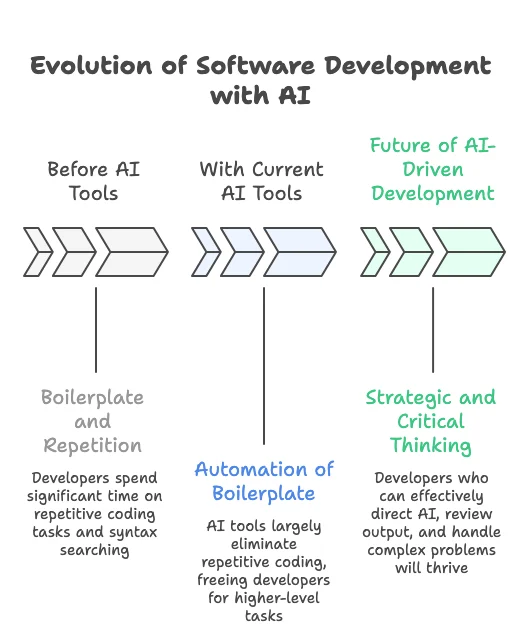
This is closer to what happened when calculators became widespread. Accountants did not disappear. The job shifted. The people who had been spending most of their time doing arithmetic were forced to develop skills in interpretation, analysis, and judgment, the things that actually required a human. The overall number of accountants went up, not down.
What this means if you are hiring or building a team
If you are a business owner evaluating whether to build software in-house or hire a development agency, the AI revolution has one clear implication: the speed of development has improved, but the need for experienced oversight has not gone down. If anything, it has gone up, because AI-generated code that ships to production without proper review creates technical debt at a pace that will hurt you six months from now.
The worst thing you can do is assume that because AI exists, you can get away with less experienced developers or fewer of them. You are trading upfront cost for downstream risk, and software maintenance is where that bill comes due.
The cheapest development is the kind you do not have to redo. AI changes the speed of the first pass, not the cost of getting it wrong.
The actual timeline to worry about
Let’s be honest about what could realistically change. Fully autonomous AI software agents that can take a vague brief, make product decisions, handle ambiguous feedback, coordinate across teams, and ship reliable software to production do not exist today. The research is moving fast, but the gap between “generates code” and “replaces a software team” is not a small one.
What is more likely over the next five years is that the productivity ceiling per developer rises significantly. A team of five experienced developers may be able to do what previously required fifteen, but you still need those five, and they need to be good. The demand for genuinely skilled developers may not collapse. It may actually increase as more businesses can now afford to build software that they previously could not.
Our take
AI is the most significant productivity shift in software development in a decade. But productivity is not the same as replacement. The developers who adapt, who learn to work with these tools, direct them intelligently, and fill the gaps they cannot fill, will be more valuable, not less. The ones who ignore these tools or treat the hype as purely overblown will lose ground. The ones who believe the hype entirely and assume AI can just handle it will ship broken software.
At Stintlief, we are actively integrating AI into how we work, not because it replaces what we do, but because it makes us faster at the parts that should be fast. That time goes back into the parts that actually require a human: understanding what clients actually need, building systems that last, and catching the problems before they become expensive.
That is the job. AI is not doing it. It is helping us do it better.