
Scroll through LinkedIn for five minutes and you’ll hit the boast: a non-technical founder who built a full SaaS product over the weekend, just by typing what they wanted into an AI. No computer science degree, no dev team, no months of work. Just an idea, described in plain English, turned into working software by Friday night.
The remarkable thing is that it’s often true. The barrier to building software has genuinely collapsed. But there’s a gap hiding inside those success stories, and it’s the difference between a demo that works on stage and a product that survives contact with real users. That gap is the whole story of vibe coding in 2026, and if you’re a founder tempted to build this way, it’s worth understanding before you bet your business on it.
Here’s the honest version, from people who get called in to fix what breaks.
What vibe coding actually is
The term was coined in early 2025 by Andrej Karpathy, a co-founder of OpenAI, and it describes something simple: you describe what you want in natural language, and AI writes the code. Not autocomplete, not snippets. You say “build me a dashboard that shows my sales by region with a login,” and the AI produces most or all of the actual application.
You direct through intent instead of typing syntax. The tools that made this real are names you may have seen: Cursor, Claude Code, Lovable, Bolt, v0 and Replit, among others. Each has a slightly different flavour, but the principle is the same across all of them. Natural language in, working software out.
That’s it. No jargon needed. If you can clearly describe a problem, you can now produce software that addresses it, at least on the surface.
Why it’s suddenly everywhere
Vibe coding isn’t a fringe experiment. By 2026 it’s a genuine market, estimated at several billion dollars and growing fast, with projections to more than double within a year. The community around it is large and loud.
The most telling statistic is who’s doing it. Well over half of active vibe coding users are not developers at all. They’re founders, product managers, designers and domain experts building full applications without ever having written code professionally. That’s not a small demographic quirk; it’s a structural shift in who is allowed to build software.
What separates 2026 from the old no-code waves is quality. Somewhere in 2024 and 2025, the AI models crossed a threshold where they could produce genuinely usable application code, not just toy prototypes. The old dismissal, that this stuff is only good for weekend hobby projects, doesn’t hold anymore. Founders are building real products with real customers and real revenue this way. That part is not hype.
What vibe coding is genuinely great at
Let’s give it full credit, because it deserves it.
It’s brilliant for validating an idea. Instead of spending months and a large budget building something nobody wants, a founder can now produce a working prototype in days and put it in front of real users. That’s a real and healthy change to how software should start.
It’s excellent for internal tools. The custom dashboard, the inventory tracker, the client portal, the little workflow app your team always wished it had but that never justified an engagement costing several lakhs. Vibe coding makes those economically viable for the first time.
It’s a fast route to an MVP. For an Indian founder trying to validate before raising money or hiring engineers, being able to test the concept cheaply first is genuinely powerful. It connects to the same logic we wrote about in whether AI will replace developers: AI raises the floor of what one person can do, and that’s a good thing.
For all of these, vibe coding is not just acceptable. It’s the smart way to start.
Where it breaks
Now the part the weekend-success posts leave out.
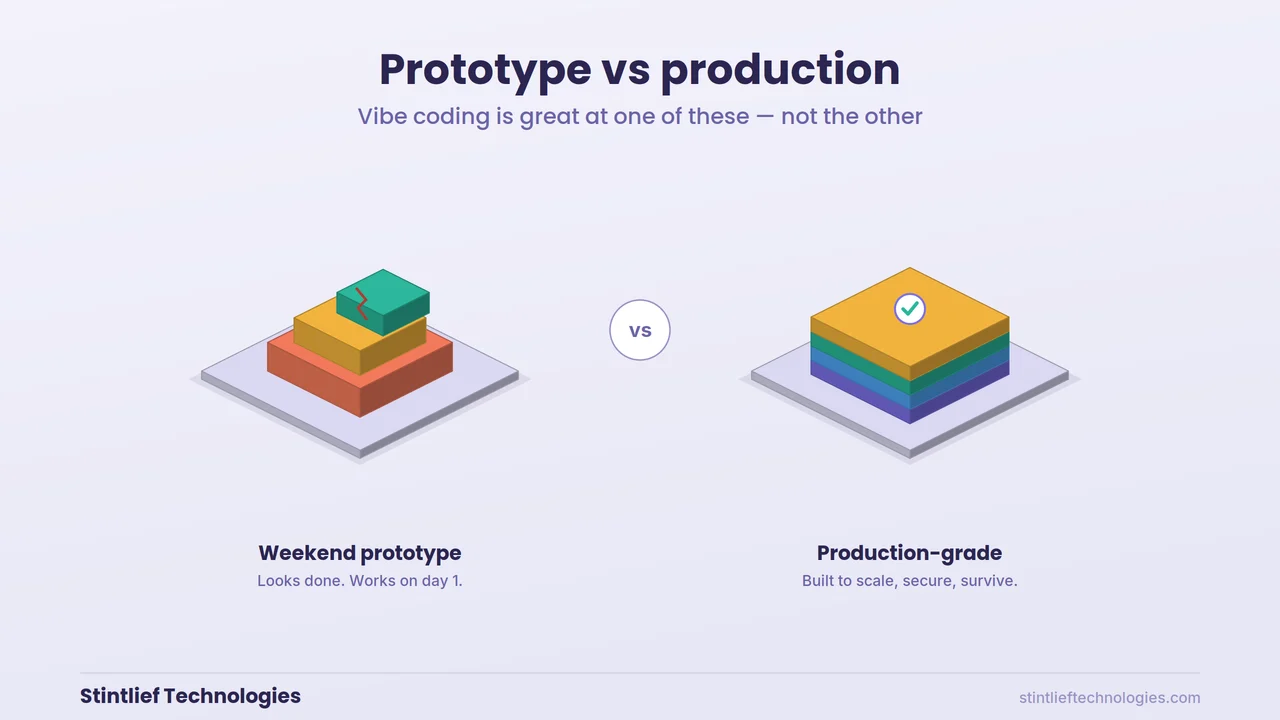
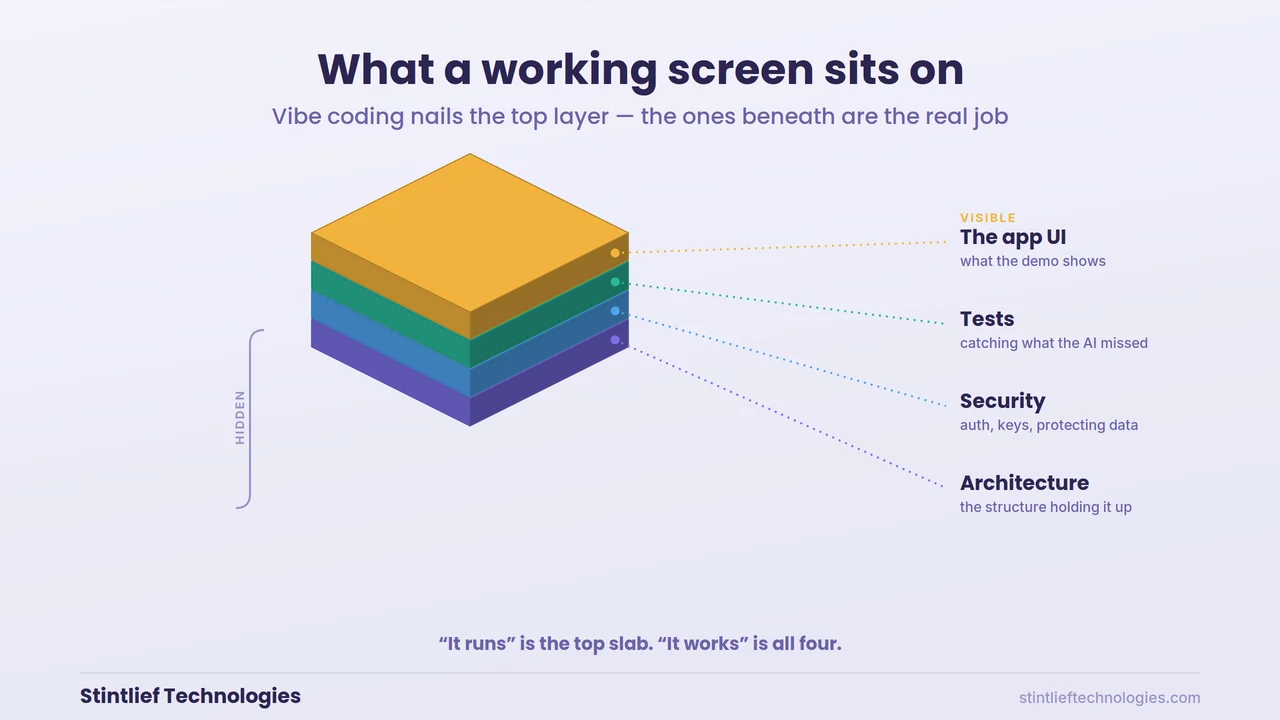
There is a stark difference between a prototype and a production-grade application, and vibe coding is far better at the first than the second. The interface can look polished and the thing can genuinely work in a demo, while underneath it lacks the structure needed to survive: consistent architecture, security controls, test coverage, the boring scaffolding that keeps software standing up under load.
The pattern is so common it has a rhythm. The product works on day one. It keeps working for a few weeks. Then, somewhere around day sixty, the founder hits a wall: a new feature that can’t be added without breaking three others, a bug nobody can trace, an integration that won’t hold. There are documented cases of vibe-coded products going live, gaining users, and then collapsing under real-world pressure, with people bypassing the subscription, API keys maxing out, and data getting corrupted, because the security and testing that a working demo doesn’t need turned out to be exactly what a real product does need.
The trust data underlines it. By 2026 the overwhelming majority of developers use AI coding tools daily, yet only around a third actually trust the code those tools produce. Adoption is racing ahead of the ability to verify what’s being produced. One study of experienced developers even found they were slower, not faster, when leaning on AI in a codebase they already knew well, because the time saved generating code was eaten by time spent reviewing and fixing it.
The uncomfortable truth of 2026: we automated writing the code, but not the harder work of making sure it actually holds.
“It runs” is not “it works”
This is the sentence worth taping to your monitor.
A vibe-coded app that runs has cleared a low bar. Making it work, in the sense that matters for a business, means something more. It means handling the edge cases the AI didn’t think of. It means the login flow being secure, not just functional. It means the app not falling over when a hundred people use it at once, and not leaking data when someone pokes at it. None of that shows up in the demo. All of it shows up in production.
The AI is confident either way. It will happily produce a login system with a hardcoded key or an app that trusts input it shouldn’t, and it will look finished. Confidence is not correctness, and on the internet, the difference is measured in incidents.
How to vibe-code responsibly
None of this means don’t do it. It means do it with your eyes open. A few habits separate the founders who thrive from the ones who end up googling “vibe code cleanup service.”
Plan before you prompt. Ask the AI to produce a plan or a structure first, read it, push back on it, and only then have it build. Ten minutes upfront saves an afternoon of unwinding bad decisions.
Treat prompts like specifications, not wishes. “Build a dashboard” gets you something vague. Describing the exact data, the users, the rules and the flow gets you something usable.
Verify ruthlessly. Assume the AI got the boring, critical things wrong until you’ve checked, especially anything touching security, payments or user data. Don’t confuse “it runs” with “it works.”
And know the line. Use vibe coding aggressively for prototypes, internal tools and validation. Be much more careful the moment real customers, real money or real data are involved.
When to bring in a development team
The smartest way to think about this isn’t vibe coding versus real engineering. It’s a sequence.
Vibe-code the prototype. Validate the idea cheaply, get it in front of users, learn what actually matters. Then, when the thing has proven itself and is about to carry real weight, that’s the point to bring in engineers, to give it the architecture, security and testing it needs to scale without collapsing. The founders who get burned are the ones who skip that second step and try to run a real business on a weekend prototype. The ones who win use vibe coding to get to the starting line faster, then build properly for the race.
This is exactly the handoff we see most often. Someone arrives with a vibe-coded product that proved the concept and is now creaking under success, and the job is to rebuild the foundations without losing what worked. There’s no shame in that path; it’s arguably the ideal one. Validate fast, then engineer for real.
At Stintlief, this is a big part of what we do now: taking a promising prototype, vibe-coded or otherwise, and turning it into something secure, scalable and maintainable. If you’ve built something with AI that’s starting to strain, the most useful starting point is a quick look at what’s holding it up, and what isn’t.
Where this is heading
The direction is not in doubt. Vibe coding adoption will keep climbing, because the value is real and the barrier is gone. The term itself may fade, the way “responsive design” stopped being a buzzword and just became how sites are built. The practice won’t fade. Describing software and having AI build the first version of it is simply becoming how software starts.
The differentiator in 2026 was never whether you use these tools. Everyone does. It’s whether you verify what they produce, and whether you know when a clever prototype needs to become real engineering. Get that judgment right, and vibe coding is one of the most powerful things to happen to founders in years.
Frequently asked questions
What is vibe coding?
Vibe coding is building software by describing what you want in natural language and letting AI write the code. Coined by Andrej Karpathy in early 2025, it shifts building from typing every line to directing an AI through intent.
What tools are used for vibe coding?
Common tools include Cursor, Claude Code, Lovable, Bolt, v0 and Replit. They differ in detail but share the same principle: you describe the app in plain language and the tool generates working code.
Can non-developers really build apps with vibe coding?
Yes. Well over half of active vibe coding users are not professional developers. Founders, product managers and designers build working applications this way, which is the biggest reason the trend has grown so fast.
Is vibe coding good enough for a real product?
It’s excellent for prototypes, MVPs and internal tools, and good for validating ideas. But a working prototype often lacks the architecture, security and testing a real product needs, so most serious products need proper engineering before they scale.
What are the risks of vibe coding?
The main risk is mistaking “it runs” for “it works.” Vibe-coded apps can look finished while missing security controls, tests and scalable architecture, leading to failures, breaches or bugs once real users arrive, often weeks after launch.
Should I vibe-code my startup or hire developers?
Both, in sequence. Vibe-code the prototype to validate the idea cheaply and quickly, then bring in engineers to rebuild it properly once it’s proven and about to carry real customers, money or data.
How do I turn a vibe-coded prototype into a real product?
By adding what the prototype skipped: a solid architecture, security controls, proper testing and scalable infrastructure, usually with an experienced development team that rebuilds the foundations while keeping what already works.
Stintlief Technologies helps founders turn prototypes into secure, scalable products, and builds custom software, web and apps for businesses across India. If your AI-built app is starting to strain, get in touch.