

A customer wants a new pair of running shoes. In 2024, they’d open Google, click through a few stores, compare, and buy. In late 2026, a growing number of them do something different: they tell ChatGPT or Gemini “find me good trail running shoes under three thousand rupees, size nine, delivered this week,” and let the AI do the rest. The agent reads the request, scans options, compares price and availability, and in the most advanced cases adds the item to a cart and checks out, all inside the chat. The customer never visits a single store’s website.
This is agentic commerce, and it’s the thing quietly reshaping how products get bought this year. The AI isn’t just recommending anymore. It’s shopping. And if your store isn’t readable by these agents, you’re not losing a ranking. You’re invisible at the exact moment the purchase happens.
We wrote recently about getting found in AI search, which is about being cited when someone asks a question. This is the next step past that: being chosen when an agent is ready to buy. Here’s how it works, and what you actually need to do about it.
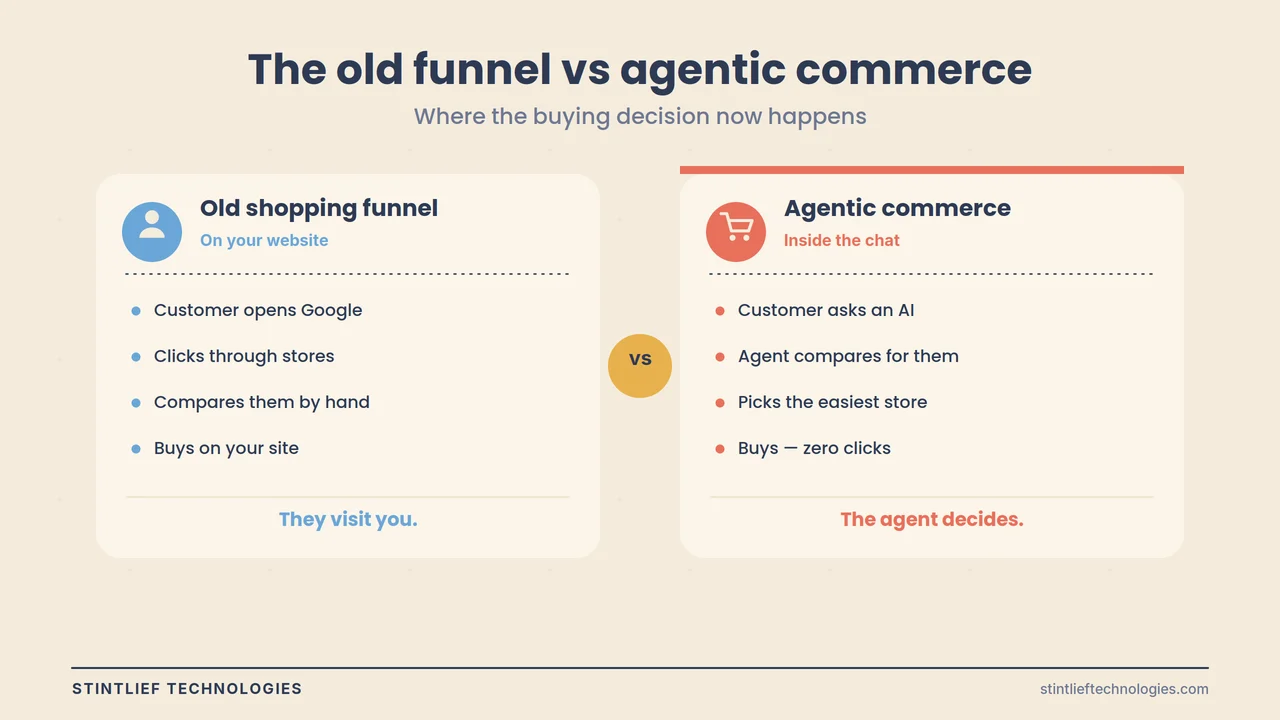
What agentic commerce actually is
Strip away the jargon and it’s simple. An AI shopping agent is an AI that handles the shopping for a customer, end to end. It runs a loop: it reads what the person wants, works out their real constraints like budget, size or delivery date, finds and compares products, and then acts, recommending, filling a cart, or in the newest setups completing the purchase itself.
Two shifts make this different from the old world.
The first is zero-click shopping. Customers can now discover products, compare them, and in some cases buy, entirely inside AI platforms like ChatGPT, Gemini and Perplexity, without ever landing on your site. The storefront you spent money on isn’t where the decision gets made anymore. As one way of putting it goes, visibility in AI channels is becoming as important as visibility in search was a decade ago.
The second is agentic checkout. New payment frameworks built specifically for AI agents are rolling out in 2026, letting an agent move from “here’s a product card” to “added to cart” to “paid” without the customer leaving the conversation. The friction between wanting something and owning it is collapsing.
This is not a far-off prediction
It’s easy to file this under “someday.” The numbers say otherwise. Industry research this year found that around 73% of consumers now use AI somewhere in their shopping journey, whether that’s research, comparison or the purchase itself. That’s not early adopters. That’s the mainstream.
And the agent-assisted sales convert. Brands running AI shopping assistants are reporting meaningfully higher average order values, often 15% or more, with some seeing agent-assisted sessions convert several times better than ordinary ones. The reason is intent: someone who hands a specific request to an agent is far closer to buying than someone idly browsing. When the agent can act on that intent cleanly, it closes.
For Indian businesses, this lands on top of a market that already lives in chat. We’ve written about how WhatsApp is becoming a sales channel; agentic commerce is the same instinct taken further, where the agent doesn’t just reply but completes the sale.
Why most stores will get skipped
Here’s the uncomfortable part. An AI agent can only recommend what it can read and trust. Most stores today are built for human eyes, not for an agent trying to extract clean facts at speed. That’s the gap.
If your product information is inconsistent, buried in images, or scattered across pages, the agent can’t reliably interpret it, so it moves on to a competitor whose data is cleaner. If your inventory feed is stale, the agent recommends something that’s out of stock, gets it wrong once, and learns to distrust you. If your policies on shipping, returns and warranty aren’t stated plainly, the agent can’t answer the customer’s “can I return this?” and drops you from the shortlist. Agent quality depends entirely on data quality, and a weak catalogue produces weak results no matter how good the underlying AI is.
The blunt version: the stores that win in agentic commerce won’t be the ones with the prettiest websites. They’ll be the ones an agent can read, trust and transact with most easily.
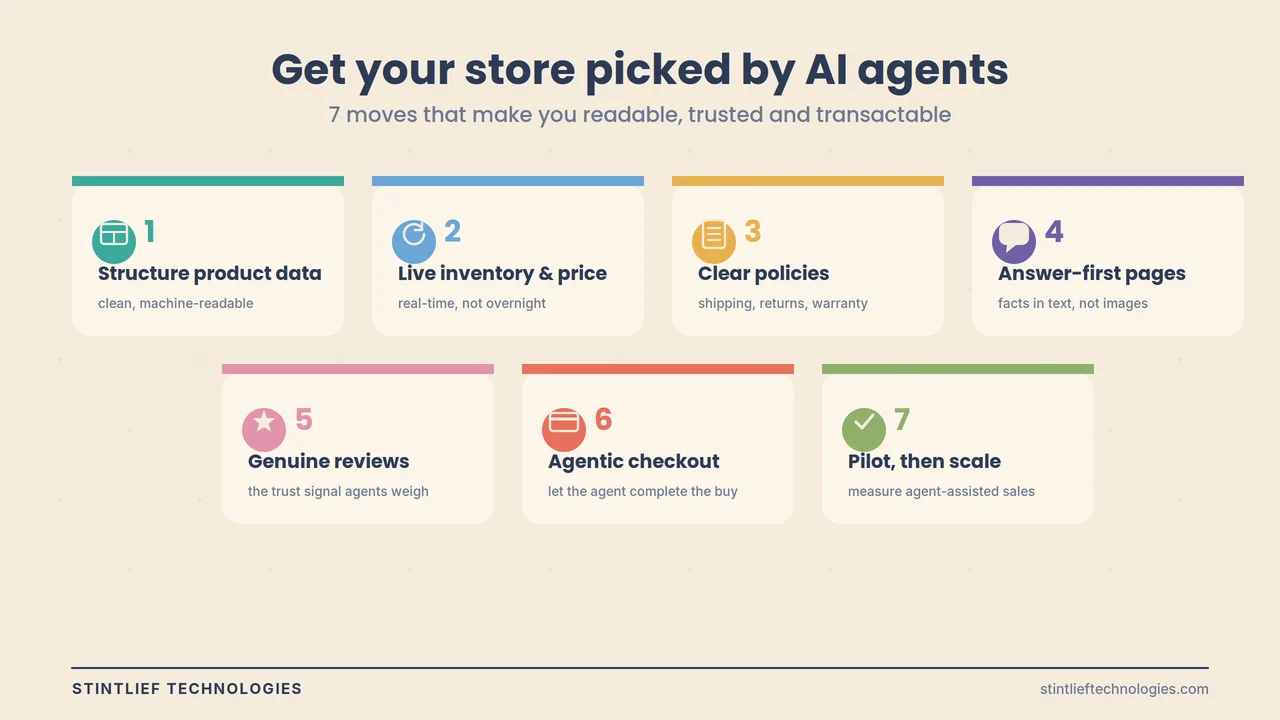
7 steps to get your store picked by AI shopping agents
You don’t need to rebuild everything. You need to make your store legible and transactable for agents. Here’s the order we’d tackle it.
1. Structure your product data for machines. Get your catalogue into clean, consistent, machine-readable form, with every product carrying the attributes a buyer asks about: size, material, price, use case, compatibility. An agent can’t recommend what it can’t interpret. This is the single highest-impact move, and most stores haven’t done it.
2. Connect live inventory and pricing. Agents need real-time stock and price, not a feed that updates overnight. Recommending a sold-out or mispriced item is how you train an agent to stop trusting you. Live feeds keep you in the running.
3. State your policies in plain language. Shipping times, return windows, warranty terms, written clearly and consistently so an agent can answer a customer’s questions on your behalf. Vague or missing policy info gets you quietly dropped from comparisons.
4. Make your product pages answer-first. The same discipline that wins AI search wins here: lead with the facts a buyer needs, in clear extractable text, not locked inside graphics. If the key details live only in a product image, the agent can’t see them.
5. Build and surface genuine reviews. Agents weigh trust signals heavily, and real customer reviews and ratings are among the strongest. Make them visible and structured. This also ties into broader AI visibility, where being mentioned and reviewed across the web shapes whether you get picked at all.
6. Enable agentic checkout where you can. As AI payment frameworks mature through 2026, being able to let an agent complete a purchase, not just view a product, is becoming a real advantage. The fewer steps between the agent’s decision and a paid order, the more often you close.
7. Run a focused pilot, then measure. Don’t boil the ocean. Pick one high-impact area, your top product pages or your checkout, run a 30-to-45-day pilot, and measure agent-assisted conversion and order value. If it pays, scale it to more products and channels. If it doesn’t, you’ve learned cheaply.
A word of realism
None of this means your website stops mattering or that every customer will suddenly shop through an agent tomorrow. Plenty still browse the old way, and will for years. Agentic commerce is a fast-growing slice of how people buy, not the whole pie yet.
The point is that the slice is growing quickly, it skews toward high-intent buyers ready to purchase, and it rewards preparation that takes time to get right. The stores that structure their data and plug into these channels now will own the agent-driven sales their competitors can’t even see. The ones that wait will spend 2027 wondering why their traffic is fine but their sales are quietly leaking to stores an agent found easier to deal with.
At Stintlief, this is squarely what we build: structured product data, live inventory and pricing integrations, and the storefront plumbing that makes a business readable and transactable for AI agents. If you run an online store, the most useful place to start is a quick look at whether an AI agent could actually read your catalogue and answer a customer’s questions about your products right now. More often than not, the answer is a wake-up call.
Frequently asked questions
What is agentic commerce?
Agentic commerce is shopping carried out by AI agents on a customer’s behalf. Instead of browsing a store themselves, the customer tells an AI what they want, and the agent finds, compares and in some cases buys the product, often entirely inside a chat platform.
What are AI shopping agents?
AI shopping agents are AI systems that handle the shopping journey for a customer, reading their request, interpreting their budget and needs, comparing products across stores, and recommending or purchasing, sometimes completing checkout without the customer visiting any website.
What is zero-click shopping?
Zero-click shopping is when a customer discovers, compares and buys products entirely inside an AI platform like ChatGPT, Gemini or Perplexity, without ever clicking through to a store’s own website. The purchase decision happens in the AI, not on your site.
How do I get my products recommended by AI shopping agents?
Make your store readable and trustworthy to agents: structure your product data in machine-readable form, connect live inventory and pricing, state policies clearly, surface genuine reviews, and enable agentic checkout where possible. Clean, consistent data is the biggest factor.
Is agentic commerce relevant for Indian businesses?
Yes. A large share of consumers already use AI somewhere in their shopping, and India’s market is heavily chat-based. As AI shopping agents and in-chat payments grow, Indian stores that are readable by agents will capture sales that competitors never see.
Does agentic commerce replace my website?
No, but it adds a new place where sales happen. Many customers still browse websites, but a fast-growing, high-intent segment now shops through AI agents. The businesses that prepare for both capture more of the market than those relying on their website alone.
How do I start preparing my store for AI shopping agents?
Begin with your product data: get it clean, consistent and machine-readable, and connect live inventory. Then add clear policies and reviews, run a short pilot on your highest-impact pages, and measure agent-assisted conversion before scaling. A development partner can handle the integrations.
Stintlief Technologies builds e-commerce stores, AI integrations and custom software that are ready for AI shopping agents, for businesses across India. If you want your store chosen by agents, not skipped, get in touch.