

App Development
Every startup founder building a mobile app eventually arrives at the same crossroads: Flutter vs React Native 2026 is the question, and picking wrong is expensive.
Not catastrophically expensive — you can migrate, it just costs months and money you probably didn’t budget for. We have seen it happen. A startup builds their MVP in Flutter, hits a hiring wall six months later when they can’t find developers to scale the product, and spends three months rebuilding in React Native. Or a startup picks React Native because “JavaScript developers are everywhere,” then discovers their complex custom UI requires so much platform-specific workaround code that the cross-platform savings evaporated.
Neither framework is wrong. Both are genuinely good in 2026. The choice that is wrong is the one made without understanding which constraints matter most for your specific situation — your team, your product, your timeline, and your market.
This is the guide we give clients when they ask us at Stintlief. It is opinionated because honest advice has to be.
Flutter vs React Native 2026: Where Each Framework Stands Today
Before getting into the decision, it is worth understanding what has actually changed in the last 18 months — because the Flutter vs React Native 2026 comparison is meaningfully different from the same comparison in 2024.
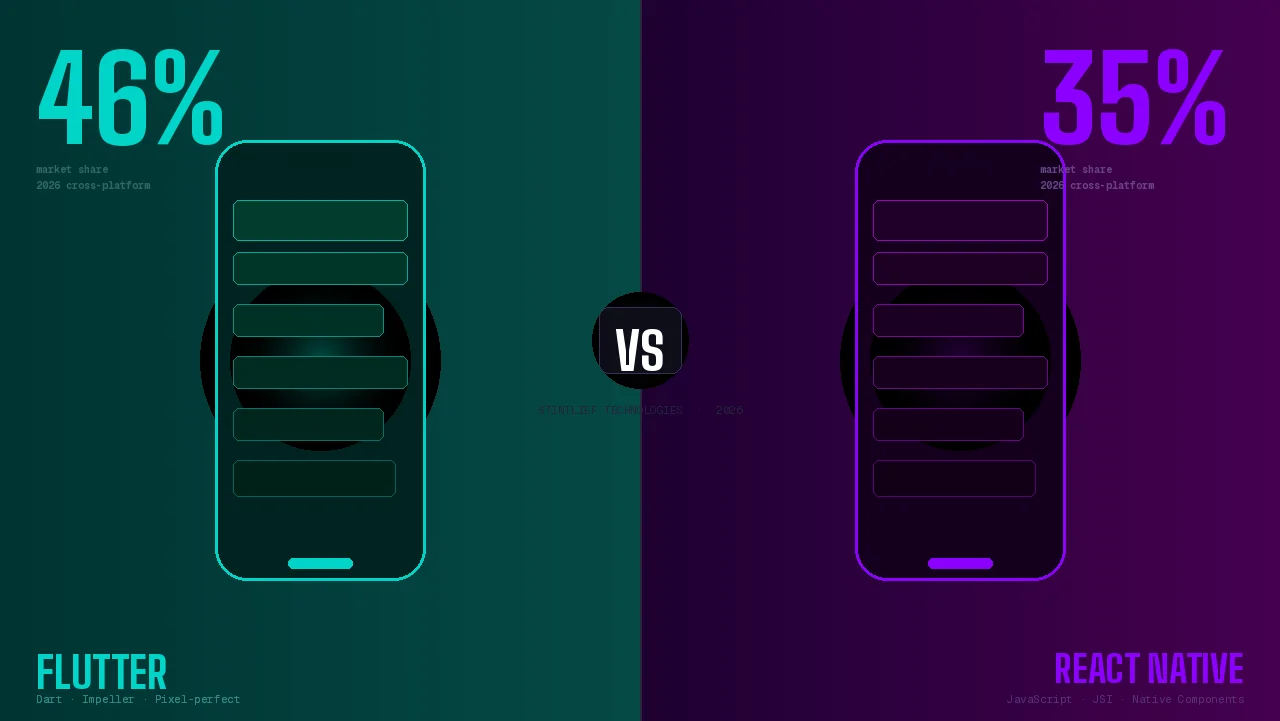
Flutter holds approximately 46% cross-platform mobile developer market share in 2026, versus React Native at 35–38%. Flutter 3.27+ ships with the Impeller rendering engine as default on both iOS and Android, replacing Skia. Impeller precompiles all shaders at build time, eliminating the “shader jank” — the frame drops during first-time animations — that was Flutter’s most persistent complaint in production. Independent benchmarks show average frame rasterisation time reduced by roughly 50% in complex scenes compared to the Skia era.
React Native shipped its “New Architecture” — Fabric renderer, JSI (JavaScript Interface), and TurboModules — and made it the default in version 0.76. This is a complete reimagining of how React Native bridges JavaScript and native code. The old asynchronous bridge was the framework’s main performance bottleneck for years. JSI replaces it with synchronous C++ memory references, dramatically reducing latency on data-intensive operations. The Hermes JavaScript engine now precompiles JavaScript to bytecode at build time, reducing startup times by 40–50% compared to the old JavaScriptCore approach.
The honest summary: both frameworks have fixed their biggest problems. Flutter fixed shader jank. React Native fixed the bridge. The performance gap that dominated every comparison article from 2021–2023 has narrowed to the point where it is irrelevant for most business applications. The decision is now almost entirely about team, hiring, and product requirements — not raw rendering benchmarks.
Flutter vs React Native 2026: The Performance Reality
Flutter still wins on raw benchmark numbers. In complex animation scenarios, Flutter consistently delivers 60fps where React Native drops to 52–58fps. At 120Hz, Flutter’s advantage is clearer. Flutter’s AOT (Ahead-of-Time) compilation of Dart into native ARM machine code produces startup times of 200–400ms for well-optimised apps. React Native, even with Hermes, typically starts in 300–600ms.
For the vast majority of business applications — forms, lists, dashboards, navigation flows, e-commerce screens, booking interfaces — this difference is invisible to users. Nobody has ever uninstalled an app because it started in 400ms instead of 250ms.
Where performance actually matters in your framework decision:
Choose Flutter for performance if your app has heavy animations, real-time graphics, gaming elements, complex custom UI components, or AR/camera processing. Flutter’s Impeller engine rendering directly to Metal (iOS) and Vulkan (Android) gives you control that React Native’s native component model cannot match.
React Native is fine for performance if your app is a standard business product — marketplaces, service apps, fintech interfaces, SaaS dashboards, food delivery, booking platforms. React Native’s New Architecture handles these patterns smoothly at 60fps, and users cannot tell the difference.
App size is one place where React Native has a real edge. Flutter bundles its own rendering engine, making a minimal Flutter app 8–12MB on Android and 15–20MB on iOS. React Native apps start smaller — 5–8MB on Android and 10–15MB on iOS — because they use platform-provided UI components. For markets where storage is a constraint (Tier 2 and Tier 3 cities in India, emerging markets generally), this is worth considering.
Flutter vs React Native 2026: The Hiring and Team Reality
This is where the Flutter vs React Native 2026 decision gets decided for most startups, and it is the dimension that most comparison articles underweight.
React Native’s hiring advantage is real and significant globally. JavaScript is the most widely-known programming language in the world. React Native job postings on LinkedIn outnumber Flutter postings by roughly 6:1 in the US market. Any experienced React web developer can transition to React Native in weeks, not months. If your team already has JavaScript or React expertise, or if you are in markets where React Native talent dominates, this is a structural advantage that technical benchmarks cannot override.
Flutter’s hiring advantage is real and significant in India. This is one of the most important India-specific facts in the Flutter vs React Native comparison that Western articles miss entirely. Flutter dominates developer communities in India, Brazil, Nigeria, and Indonesia — markets where Google invested heavily in Flutter developer programs, GDG chapters, and university curriculum. In Indian metro cities, Flutter developers are increasingly available and often at competitive rates. In the Indian market specifically, Flutter’s talent pool is less of a constraint than it would be in the US or Europe.
For startups building in India with plans to hire Indian developers, the React Native hiring advantage is less decisive than it appears in global data.
The hidden cost of wrong-framework hiring: One startup we know built their product in Flutter, could not find qualified Flutter developers to maintain and scale it six months post-launch, and spent three months and significant money rebuilding in React Native. The benchmarks were irrelevant. The hiring market was the constraint. Know your hiring market before you choose your framework.
Flutter vs React Native 2026: Development Cost in India
In the Indian market, real cost figures look like this:
| App Type | Flutter (India) | React Native (India) |
|---|---|---|
| Basic app | ₹3–5 lakh | ₹4–6 lakh |
| Mid-level app | ₹5–14 lakh | ₹6–16 lakh |
| Enterprise app | ₹15–25 lakh+ | ₹16–28 lakh+ |
Flutter’s cost advantage in India comes primarily from faster development speed — single codebase, faster hot reload, fewer platform-specific workarounds for standard UI patterns. React Native can be cheaper if you already have a JavaScript team, because the onboarding time is lower. For a net-new hire, the training curve on Dart versus JavaScript is the main variable.
Long-term maintenance costs tend to favour Flutter. React Native’s reliance on third-party packages means ongoing dependency updates, occasional breaking changes when a library stops being maintained, and periodic bridge-related bugs. Flutter’s widget system and Google’s tighter control over the ecosystem produce more consistent long-term stability. For a product you plan to maintain for three to five years, this matters more than the initial build cost.
Flutter vs React Native 2026: UI and Design Differences
This dimension is where the choice is most clear-cut.
Flutter gives you pixel-perfect control across every device. Because Flutter draws every pixel itself through Impeller, what you design is what you get — on a ₹8,000 Android phone, on a Samsung Galaxy S26, and on an iPhone 17. There is no platform UI component interpretation, no Android-vs-iOS inconsistency, no “this looks slightly different on some devices.” If your product’s competitive advantage is its design — fintech apps with custom interactions, lifestyle apps with distinctive visual identity, any app where the experience is the product — Flutter is the right choice.
React Native gives you platform-native feel automatically. Because React Native uses actual iOS and Android UI components, an iOS user gets iOS bounce physics, iOS scroll behaviour, iOS navigation patterns. An Android user gets Material Design ripples, Android-style transitions. For apps where users expect platform conventions — productivity tools, enterprise dashboards, utility apps — this native feel is genuinely better than what Flutter produces by default. Flutter can replicate it, but you are doing manual work to match behaviour that React Native delivers automatically.
Neither is universally better. It depends entirely on what your product needs to feel like.
Flutter vs React Native 2026: Ecosystem and Libraries
React Native’s ecosystem is larger, older, and broader. The npm ecosystem — billions of JavaScript packages — is available to React Native projects. Community libraries cover almost every use case imaginable, with Shopify’s open-source React Native contributions and Microsoft’s Windows support adding significant depth. If you need to integrate with something unusual, there is probably a React Native package for it.
Flutter’s ecosystem is smaller but more cohesive. pub.dev hosts Flutter and Dart packages, and while the total count is lower than npm, the quality and reliability tend to be higher because Flutter’s tighter language constraints make packages easier to maintain. Google maintains first-party plugins for most common use cases — camera, maps, in-app purchases, notifications — with consistent updates. You are less likely to encounter the “this library hasn’t been updated in two years” problem that affects React Native projects.
For Indian startup products — food delivery, edtech, healthtech, fintech, logistics — the required integrations are well-covered by both ecosystems. Payment gateways (Razorpay, PhonePe, Paytm), mapping (Google Maps), cloud messaging (Firebase), biometrics — all work reliably on both frameworks.
The India-Specific Context for Flutter vs React Native 2026
Most comparison articles are written for US or European markets. The Indian context shifts several factors.
Device fragmentation is extreme. India has over 1 billion smartphone users on a massive range of Android devices — from ₹6,000 entry-level phones to flagship models. Flutter’s consistent rendering engine means your UI looks identical on every device, which is genuinely valuable in a fragmented market. React Native’s native component model means your UI is rendered differently on different Android versions and manufacturers, which can produce inconsistencies on lower-end devices.
Flutter developer supply is growing fast in India. Unlike Western markets where React Native’s hiring advantage is substantial, in India the Flutter developer community has grown significantly through Google’s investment in local developer programs. For startups hiring in Bengaluru, Hyderabad, Pune, or remote Indian talent pools, Flutter is often as accessible as React Native.
MVP speed matters more in Indian markets. Many Indian B2C startups operate in competitive categories where reaching market first — or reaching market before a competitor pivots — is more important than technical elegance. Both frameworks deliver similar speed for standard MVP builds. The question is whether your team has existing JavaScript or Dart familiarity, which determines which framework is actually faster for your specific team.
Flutter vs React Native 2026: The Decision Framework
After working through this decision for many clients, the questions that actually determine the right answer are:
Question 1: What is your team’s existing language background? JavaScript or React web experience → React Native is faster to start and easier to hire for. No existing mobile or web experience → Flutter’s slightly steeper initial learning curve (Dart) pays off with faster long-term development once mastered.
Question 2: Does your product’s competitive advantage depend on its design? Yes, custom UI is central to your product → Flutter. No, standard business patterns are fine → either framework works; default to your team’s strength.
Question 3: Where are you hiring developers? India, Brazil, or other markets where Flutter communities are strong → Flutter’s talent pool is viable. US, UK, or markets with established React ecosystems → React Native’s hiring advantage is more significant.
Question 4: Do you need platform-native behaviour on both iOS and Android? Yes, your app must feel like a real iOS app and a real Android app → React Native. No, consistent cross-platform experience is fine or preferred → Flutter.
Question 5: Are you planning to expand beyond mobile? Web and desktop from a single codebase → Flutter has better multi-platform support in 2026. Mobile only for the foreseeable future → either framework is fine.
What We Recommend at Stintlief
We build both. We have shipped Flutter apps and React Native apps for clients across fintech, edtech, food delivery, logistics, and SaaS. Here is our honest guidance:
For most Indian startups building their first app: we lean toward Flutter in 2026. The hiring market in India has matured enough that talent is available. The single codebase, faster iteration cycle, and consistent performance across India’s fragmented Android device landscape are meaningful advantages. The cost figures in the Indian market are similar enough that hiring reality dominates the decision more than build cost.
For startups with existing JavaScript or React teams: React Native is the right call. The framework choice should reduce friction, not introduce it. A React web team can ship a React Native MVP faster than they can ship a Flutter MVP — that time advantage is real money.
For design-led products: Flutter, unambiguously. If your differentiation is your product’s look and feel, you want the framework that gives you total control over every pixel.
The one thing to avoid: choosing a framework based on a benchmark article and then discovering your hiring market doesn’t support it. Know where you are hiring developers before you commit to a stack.
Flutter vs React Native 2026: Quick Comparison
| Factor | Flutter | React Native |
|---|---|---|
| Language | Dart | JavaScript / TypeScript |
| Rendering | Custom (Impeller engine) | Native platform components |
| Performance | Slightly better raw benchmarks | Excellent for standard business apps |
| UI consistency | Identical across all devices | Platform-native feel per OS |
| Hot reload | Faster, state-preserving | Fast Refresh — very good |
| India hiring | Strong and growing | Strong |
| Global hiring | Smaller talent pool | Larger talent pool |
| App size | 8–12MB+ (bundled engine) | 5–8MB (uses platform components) |
| Ecosystem | Cohesive, Google-maintained | Larger, broader, more varied |
| Multi-platform | Mobile, web, desktop, embedded | Mobile-primary |
| Best for | Custom UI, design-led products | JS teams, business apps, native feel |
| India cost (basic app) | ₹3–5 lakh | ₹4–6 lakh |
If you are working through the Flutter vs React Native 2026 decision for a specific product, talk to the Stintlief team. We build with both frameworks and will tell you honestly which one fits your situation — not which one we find easier to sell.