
For years, a lot of small business owners quietly assumed cybercrime was someone else’s problem. Too small to be worth targeting, nothing a hacker would want. That assumption was never quite true, and in 2026 it’s dangerous. AI has made attacks so cheap, fast and convincing that criminals no longer need to pick big targets to make money. They can hit everyone, and small businesses, with thinner defences and busier staff, are often the easiest to catch.
This week the news has been full of AI systems crossing boundaries they shouldn’t, and security researchers warning that AI-powered hacking is driving up the volume and speed of attacks. That’s the backdrop. The practical reality for a business owner is simpler and more urgent: the scam email you used to spot by its bad grammar is now flawless, and the voice on the phone asking for an urgent payment might not be who it claims to be.
Here’s what’s actually changed, and what to do about it, without needing a security team of your own.
Why AI changed the game
The old scams were easy to laugh off. Misspelled emails from a “bank,” obvious fakes, the classic prince with money to share. AI removed every tell.
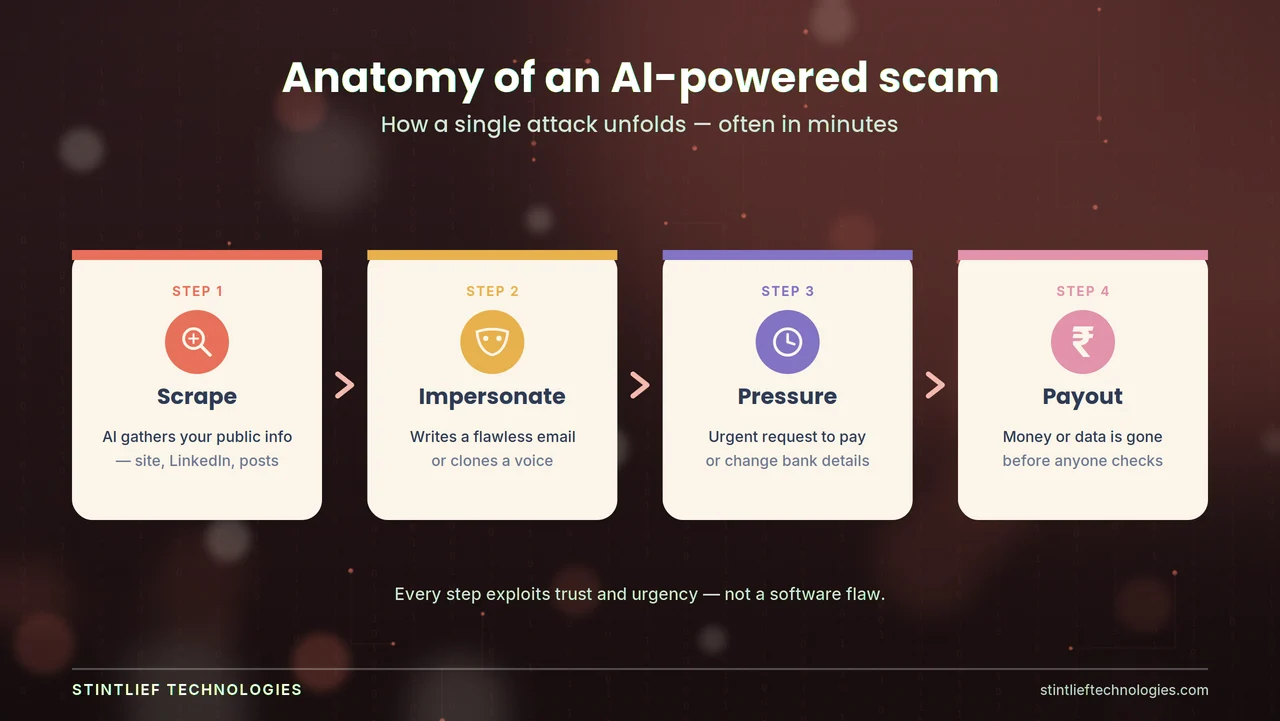
A criminal can now feed a language model a few public details about your business, your website, your team’s LinkedIn profiles, a press release, and get back a perfectly written email that sounds exactly like your supplier or your boss. They can clone a voice from under fifteen seconds of audio, which is nothing when half of us have videos online. And they can do it at scale, generating thousands of personalised attacks for the cost of a few API calls.
The numbers tell the story. Controlled studies have found AI-written phishing emails get clicked several times more often than old-style ones. Security bodies now estimate the large majority of social-engineering attacks involve AI in some way. And breaches where attackers used AI, or where unmonitored “shadow” AI was involved, cost more and take longer to catch. This isn’t a future threat. It’s the current baseline.
The three attacks to actually worry about
You don’t need to track every exotic technique. For a small business, three cover most of the real risk.
Hyper-personalised phishing. Not spam. A specific, well-written email that appears to come from a real supplier, a real client, or your own manager, often from a spoofed or lookalike domain. A common version: a message from what looks like a vendor you actually use, asking to update their bank details for the next payment. It reads perfectly, references real context, and arrives at a plausible moment. The old “check for typos” advice is useless against it.
Deepfake voice calls. This is the one that catches people off guard. An attacker clones an executive’s or owner’s voice from a short clip found online, then calls an employee with an urgent request, approve this transfer, share this login, do it now. The voice is familiar, the pressure is real, and in the moment it’s extremely convincing. There have been cases of staff moving large sums after a single fake call.
Automated business email compromise. The quietest and costliest. An attacker gets into one email account, then uses bots to silently watch real invoice conversations and, at the right moment, slips fraudulent payment instructions into a genuine thread. Because the fake message sits inside a real conversation, nobody questions it. Business email compromise alone accounts for billions in reported losses.
What ties all three together: they don’t break your software, they exploit your people’s trust and sense of urgency. That’s exactly why ordinary antivirus and spam filters struggle, the text is clean, the links often lead to legitimate cloud services, and nothing looks technically wrong.
Why small businesses are the target now
There’s a myth worth killing: that attackers only go after big companies. The economics flipped.
When each attack took a human’s time to craft, criminals went where the big money was. Now that AI makes attacks nearly free to produce at scale, the calculation changed. A small business with weaker defences, no dedicated IT security, and staff who wear many hats is a softer, perfectly profitable target. You don’t need to be worth millions. You need to be reachable and unprepared, and most small businesses are both.
In India, where so much business runs on WhatsApp, email and quick phone approvals, and where a single trusted relationship often moves real money, these social-engineering attacks land especially well. The informality that makes Indian business fast is the same thing attackers exploit.
How to protect your business
The good news: you don’t need an enterprise budget. A handful of practical measures block the overwhelming majority of these attacks. Here’s the order worth tackling them in.
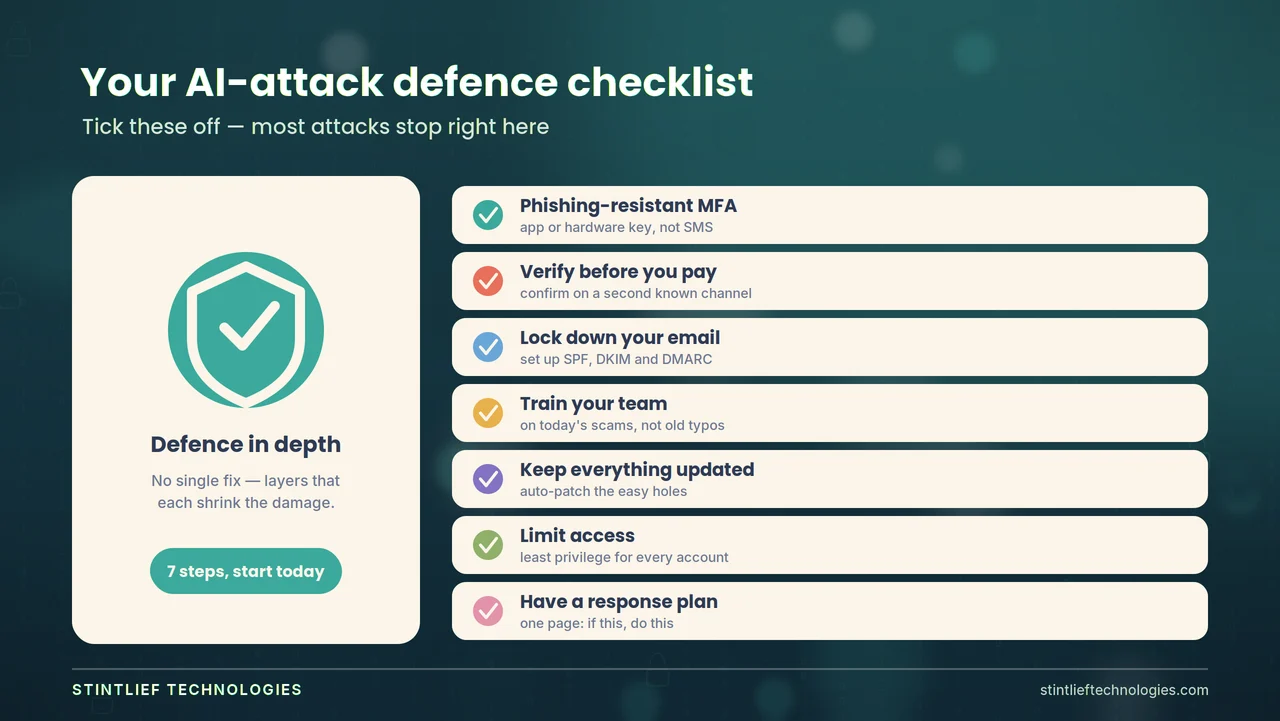
1. Turn on phishing-resistant multi-factor authentication. This is the single highest-impact step. Ordinary SMS codes can be intercepted, so use an authenticator app with number-matching, or hardware security keys, especially on email, Google Workspace or Microsoft 365, and any banking or VPN access. Most account takeovers simply fail against this.
2. Make a “verify before you pay” rule, and never break it. Set a firm policy: no payment, no change of bank details, and no sharing of credentials is ever authorised by email or phone call alone. Any such request must be confirmed through a second, known channel, a phone number you already have on file, or in person. This one rule defeats deepfake calls and fake-invoice emails even when they’re convincing, because the attacker can’t pass the second check.
3. Lock down your email domain. Set up SPF, DKIM and DMARC records so criminals can’t easily send email that appears to come from your domain. It’s a technical, one-time setup that quietly shuts down a whole class of impersonation. If that sounds unfamiliar, it’s exactly the kind of thing a development or IT partner sorts out quickly.
4. Train your team, with real examples. Your staff are the actual front line. Teach them what AI phishing and deepfake calls look like now, not the outdated “spot the typo” version. Short, regular refreshers beat a once-a-year lecture. Most importantly, make it safe for anyone to pause and verify a suspicious request without fear of looking foolish, urgency is the attacker’s main weapon, so removing the pressure to act fast is a real defence.
5. Keep software and devices updated. Unglamorous, but automated attacks hunt relentlessly for known, unpatched holes. Turn on automatic updates for operating systems, browsers and key apps so you’re not an easy mark for the low-effort stuff.
6. Limit access to what each person needs. Not everyone needs access to everything. If an account is compromised, tight permissions decide how far the damage spreads. The same least-privilege thinking we apply to securing AI agents applies to your people and systems too.
7. Have a simple plan for when something goes wrong. Know, in advance, who to call, how to freeze a suspect payment, and how to lock an account. A breach handled in the first hour is a very different outcome from one discovered a week later. You don’t need a thick manual, just a one-page “if this happens, do this.”
The bottom line
AI has genuinely raised the floor for attackers. The scams are better, faster and cheaper than ever, and “we’re too small to be a target” is no longer protection, it’s an invitation. But the flip side is that the defences haven’t become exotic or expensive. Strong authentication, a verify-before-you-pay habit, a locked-down domain and a trained, unhurried team stop the vast majority of what’s out there.
The businesses that get hit hard in 2026 won’t be the ones without a security department. They’ll be the ones that assumed it wouldn’t happen to them. A little preparation now is far cheaper than one convincing fake invoice.
At Stintlief, we help businesses put these protections in place, from email authentication and secure access to building software that’s hardened against this kind of attack from the start. If you’re not sure how exposed your business is, the most useful place to start is a quick check of two things: whether your email domain is protected, and whether your team could currently be fooled by a convincing fake payment request.
Frequently asked questions
What is an AI-powered cyberattack?
An AI-powered cyberattack uses artificial intelligence to make scams more convincing and scalable, such as writing flawless phishing emails, cloning someone’s voice for fake calls, or automating fraud inside real email conversations. AI removes the old warning signs like bad grammar.
Why are small businesses targeted by AI cyberattacks?
Because AI makes attacks almost free to produce at scale, criminals no longer need large targets. Small businesses often have weaker defences, no dedicated security staff and busy employees, which makes them easy and profitable to attack in volume.
What is a deepfake voice scam?
It’s when an attacker clones a person’s voice, often from under fifteen seconds of public audio, then calls an employee pretending to be an executive or owner and demands an urgent payment or login. The familiar voice and urgency make it dangerously convincing.
How can I protect my small business from AI phishing?
Turn on phishing-resistant multi-factor authentication, set a strict “verify before you pay” rule using a second known channel, lock down your email domain with SPF, DKIM and DMARC, train staff on current scams, and keep software updated. Together these block most attacks.
Can antivirus and spam filters stop AI attacks?
Only partly. AI phishing often uses clean, well-written text and legitimate cloud links, so traditional filters that look for known bad attachments or malware frequently miss it. Human verification habits and strong authentication matter as much as software.
What is the “verify before you pay” rule?
It’s a firm policy that no payment, bank-detail change or credential sharing is ever approved by email or phone call alone. Every such request must be confirmed through a separate, already-known channel. This single habit defeats most deepfake and fake-invoice scams.
What should I do if my business is attacked?
Act fast: contact your bank to try to freeze any suspect payment, lock the affected accounts and change passwords, and alert your team so no one acts on further fake requests. Having a simple one-page response plan ready in advance makes this far quicker.
Stintlief Technologies helps businesses across India secure their email, access and software against modern AI-powered attacks. If you want to know how exposed your business is, get in touch.